
Beyond the Single Brain: How 'Agent Societies' Will Redefine Human-Robot Interaction
2026-10-23 16:23:35 by Queenie Tan
On October 22, outside the special forum titled "From Interaction to Symbiosis: Brain-Computer Interfaces and Embodied Intelligence" at the 23rd China Computer Federation National Conference, a humanoid robot drew significant attention. It performed a dance routine on-site and demonstrated movements including kneeling on one knee, boxing, and side kicks, capturing the interest of attendees.
"There will be no sudden emergence of a 'single superbrain' that dominates everything. The next intelligence explosion is more likely to stem from multi-agent collaboration, human-machine hybridization, and institutionalized alignment, ultimately forming an 'agent society'".
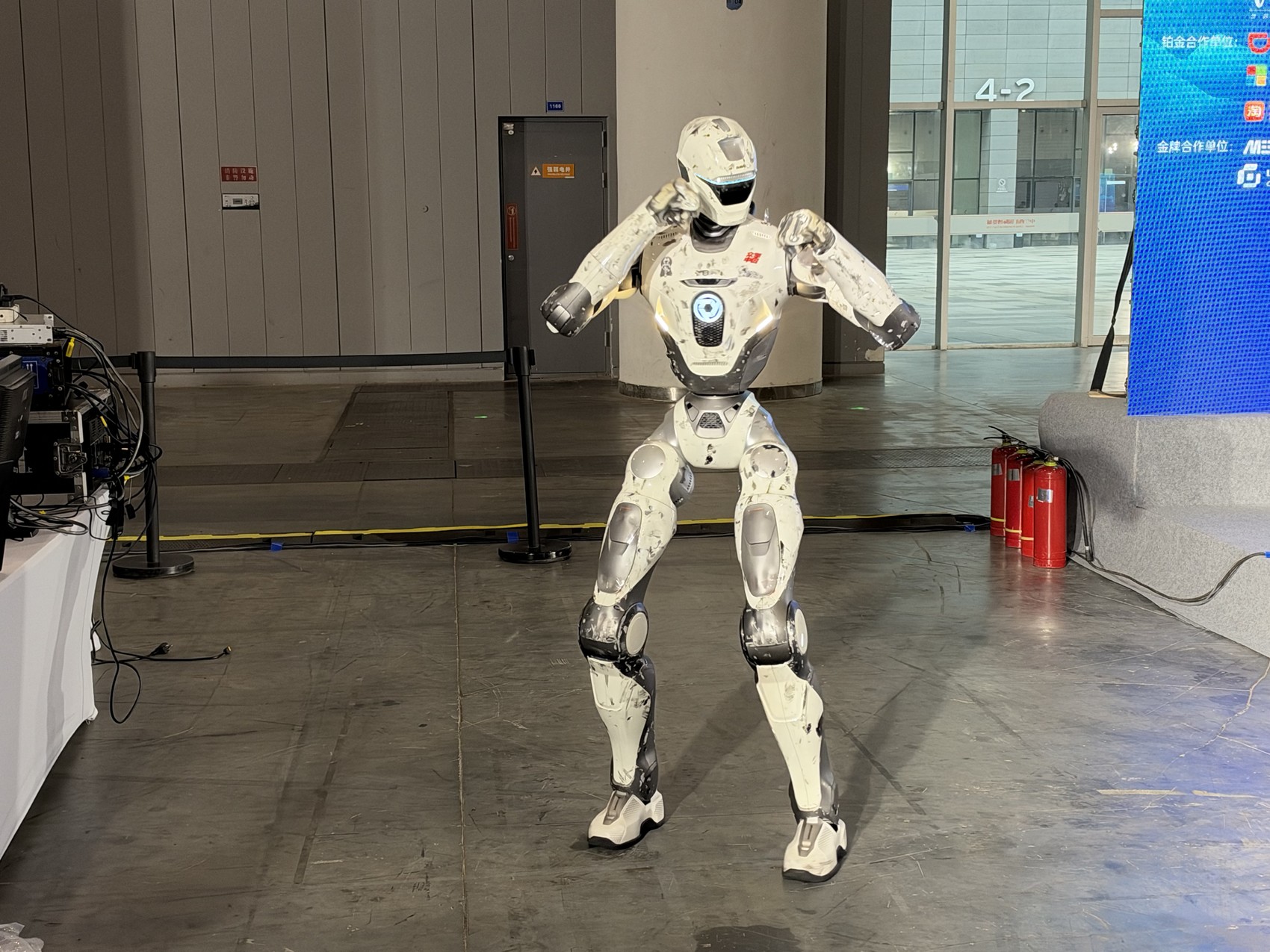
Humanoid robots struck various poses on-site, drawing significant attention
According to Sun Changyin's vision, the so-called "agent society" does not involve a single AI system completing tasks independently; rather, it entails multiple agents with distinct capabilities working in coordination, with humans also participating, to jointly solve complex problems.
Therefore, enabling artificial intelligence to understand human needs, adhere to established rules, and function under safe and controllable conditions will become a key direction for the future development of intelligent systems.
Sun Changyin believes that embodied intelligence represents a critical pathway for AI to enter the physical world, providing theoretical support and implementation approaches for autonomous unmanned systems. In the long term, the integration of brain-computer interfaces and embodied intelligence could further transform the way humans and machines collaborate.
"The move toward large-scale application of embodied intelligence still faces three major challenges: scarcity of real-world data, high trial-and-error costs, and limited generalization capabilities", noted Tian Yonghong, a Boya Distinguished Professor at Peking University. He explained that scientists are exploring "world model" technologies to help AI learn physical laws, predict action outcomes in virtual environments, and reduce real-world trial and error.
However, world models are not a panacea. Tian pointed out that unresolved challenges remain, including how to run complex models with limited computing power, adapt training outcomes to diverse tasks, and translate realistic simulations into effective action strategies.
To address these issues, he proposed advancing the evolution of world models from "single models" to "cloud-device integrated intelligent systems", achieving comprehensive coordination through cloud-based training, edge-side learning, and collaborative optimization.
This implies that future advancements in robotic intelligence will rely not solely on powerful models, but increasingly on close collaboration among models, devices, and real-world environments.
【本篇文字部分内容由 AI 辅助写作,特此声明。Please note: the text in this article was created with the help of AI.】
