
Sichuan: Idle Shops Reborn as Rural Artisan Hub
2026-10-21 15:56:16 by Queenie Tan
"Now approaching is the wheat straw ink painting 'Cat Playing with a Butterfly', created by rural artisans. Using wheat straw as the medium, the cat and butterfly are rendered with lifelike vividness, showcasing the artisan's spirit within a compact frame."
On Oct. 20, a unique "Artisan Fashion Show" took place in Zhanqi Village, Chengdu. On that day, the province's first Rural Artisan Park officially opened in Zhanqi Village. At the opening ceremony, the main performers who took the stage to sing, recite poetry, and demonstrate their special skills were all rural artisans.
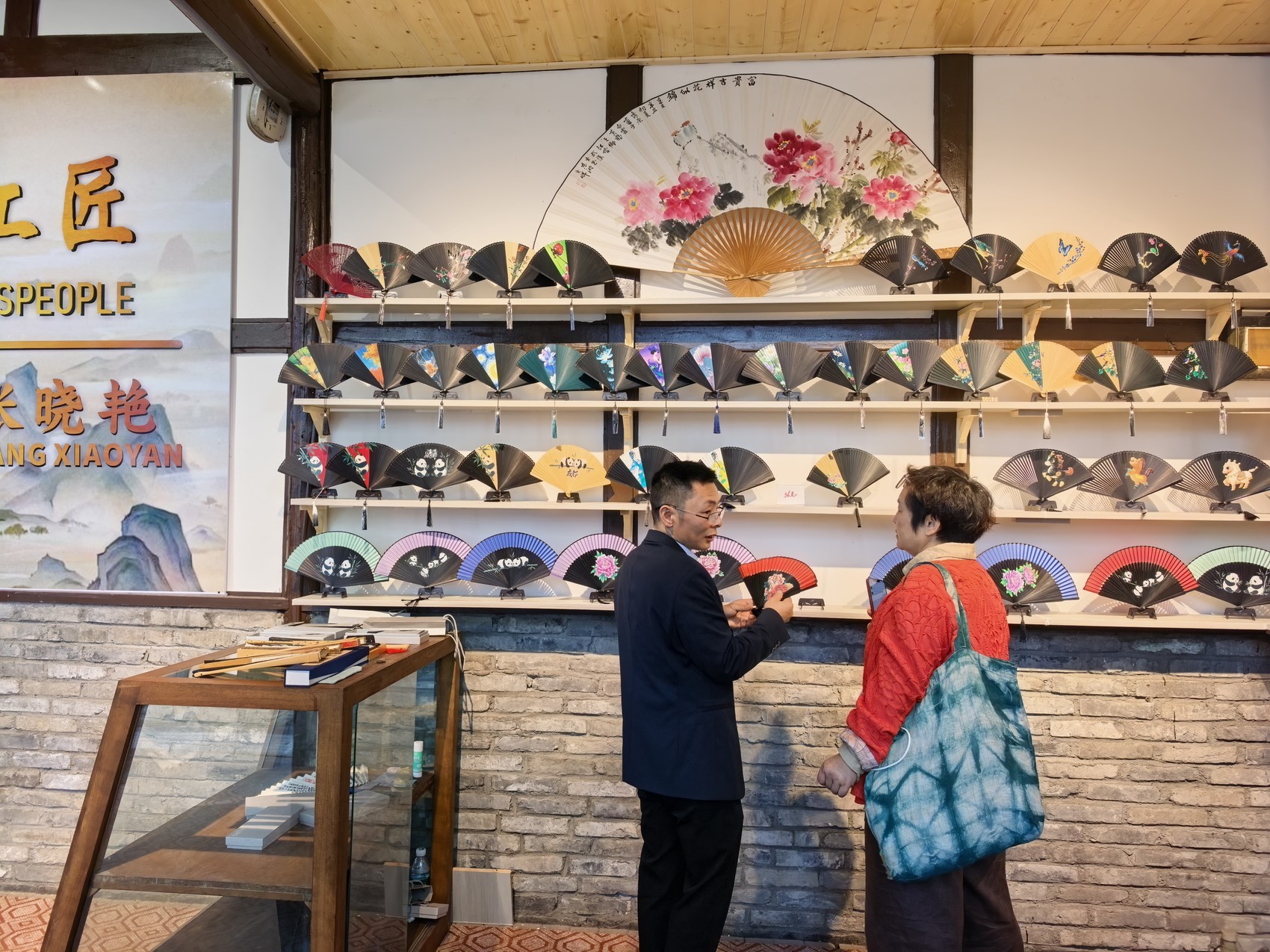
Folding fan works displayed by Kong Jian
By the end of August 2026, Sichuan Province had cultivated and certified a total of 11,570 rural artisans. How can the government better set the stage for artisans to showcase their talents? Relying on previously idle shops, the Provincial Rural Artisan (Zhanqi) Park has attracted more than 20 artisans to settle in at low cost, fostering clustered development across multiple categories. This approach offers a potential solution to longstanding challenges faced by individual artisans, such as weak operational capabilities and limited marketing channels.
At 9 a.m., the "Jifeng Courtyard" within the Rural Eighteen Workshops of Zhanqi Village began to bustle with activity as the first wave of tourists streamed in, eagerly exploring the 23 newly opened storefronts. The signboards above these shops are uniformly engraved with four Chinese characters: "Rural Artisans".
Kong Jian, a provincial-level rural artisan from Nanbu County, Nanchong City, and an inheritor of the intangible cultural heritage of Nanbu Kong-style folding fans, welcomed wave after wave of visitors. "How exquisite these carving and pyrography techniques are!" Amidst repeated exclamations of admiration, Kong Jian's fan inventory dwindled rapidly.
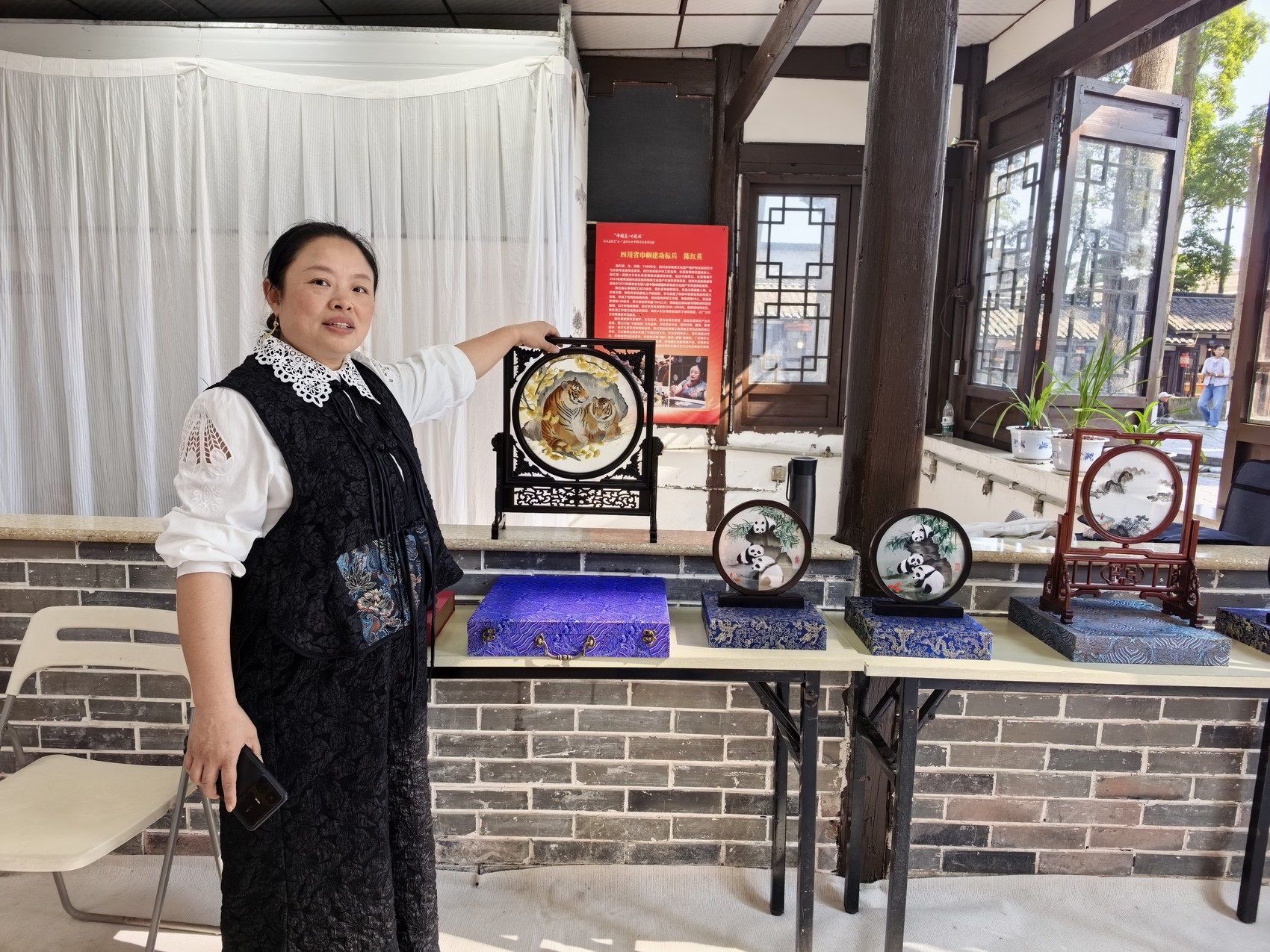
Shu embroidery works displayed by Chen Hongying
"We haven't done much promotion since just opening, yet we're already making over 300 yuan a day," Kong said, noting that the massive foot traffic was one of the key factors attracting him to the park. Statistics show that Zhanqi Village, a national 4A-level tourist attraction, draws approximately 1.2 million visitors annually, serving as a "traffic foundation" for transforming traditional craftsmanship into marketable products and turning skills into industries. "Beyond needing a larger platform for display, we also hope to find more business opportunities here," he added. While chatting with reporters, a special visitor entered Kong's shop. After inquiring in detail about the folding fan craftsmanship and pricing, the two exchanged WeChat contacts and agreed to hold further discussions regarding supply arrangements.
Meanwhile, the shop operated by Chen Hongying, a provincial-level master rural artisan and an inheritor of the intangible cultural heritage of Shu embroidery from Lezhi County, is the largest in the complex. "It covers about 60 square meters, and thanks to government subsidies, the monthly rent is only a little over 400 yuan," she explained. Renting the largest space in one go reflects Chen's strategic planning. "There are many tourists here, and we have already partnered with a travel agency to launch study tour programs focused on Shu embroidery," she said. With ample space to set up embroidery frames, the shop allows visitors to experience the unique charm of Shu embroidery firsthand.
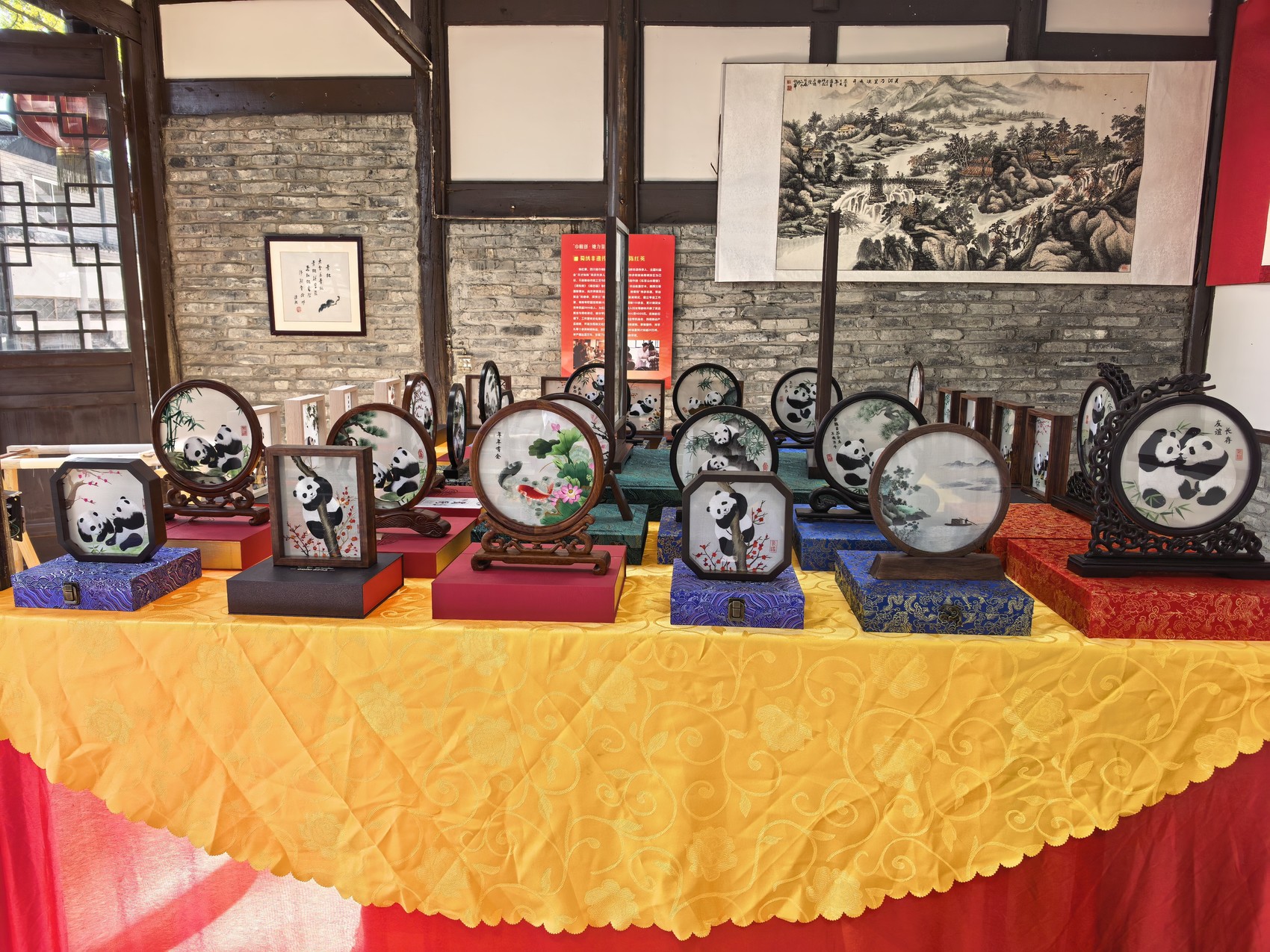
Shu embroidery works displayed by Chen Hongying
Chen noted candidly that traditional craftsmanship must not only be passed down but also shared widely, ultimately becoming a source of livelihood for local residents. Previously, she established two studios and has trained more than 1,000 students in total, some of whom have increased their monthly income by 2,000 to 4,000 yuan. "I plan to replicate this model in the park, helping nearby residents master a skill that can lead to prosperity so they can earn money right at their doorsteps," Chen said.
"Currently, the province has cultivated and certified 11,570 rural artisans, but they are scattered across various cities and prefectures in a relatively fragmented manner. How can we create a new platform for artisan aggregation, a new hub for skill inheritance, and a new vehicle for enriching people through industry? Our answer is the innovative establishment of the Provincial Rural Artisan Park," said a relevant official from the Provincial Department of Agriculture and Rural Affairs. The park focuses on recruiting provincial-level rural artisans specializing in bamboo weaving, Shu embroidery, traditional brewing, woodcarving and stone engraving, and folk cultural creativity. It has initially formed a development pattern characterized by "artisans from across the province gathering in Zhanqi, one workshop dedicated to each craft, and each workshop featuring a unique product and distinctive character".
The "Jifeng Courtyard" was once a bustling hub: villagers' snack stalls and specialty shops thrived here. However, due to various factors, business gradually declined, shops closed down, and dust settled on doors and windows. During that period, Wang Yu, deputy secretary of the Zhanqi Village Party Committee, was deeply anxious: how could the 23 idle storefronts, covering nearly 400 square meters, be revitalized? And how could the village collective economy receive another boost?
Revitalization cannot simply mean replicating the old model. "It's not just about 'building it up', but also about 'bringing it to life'. We need to upgrade from merely 'having business formats' to 'becoming a model site'," said a relevant official from Pidu District. After extensive research, they set their sights on the strategy of "revitalizing industry through craftsmanship and enriching the people through art". The approach of "reactivating idle assets at low cost to build a carrier for clustered artisan development" was finalized.
Wang Yu repeatedly emphasized the concept of "low cost": shop rent is set at 12 yuan per square meter per month, with the government subsidizing 5 yuan, meaning artisans pay only 7 yuan per square meter to move in. "Calculated this way, the monthly rent for some shops is just around 100 yuan," he explained.
This revenue alone is not substantial. So how does the village collective economy benefit? "We are looking at the bigger picture. What matters most is greater foot traffic and longer visitor stays," Wang said. Traditional handicrafts carry inherent "cultural genes" and are accelerating their transformation from "courtyard artworks" into cultural and creative products, educational study tour items, and tourism souvenirs, which will undoubtedly attract more visitors. Meanwhile, the addition of new scenes in the countryside will help retain tourists more effectively. "If visitors spend 10 minutes in each shop, they'll stay an extra hour or so. When mealtime comes, won't they naturally stay in our village for a meal?" Wang remarked.
Industry insiders note that while the park's opening marks the starting point, sustainable operations hold the key to success. Beyond "making artisans visible and giving skills a stage", the fundamental requirement for the park to truly thrive is ensuring "products have sales channels and operations receive adequate support." "Our goal is to make the platform more practical and products more marketable," said a representative from the Sichuan Rural Development Foundation. The foundation will accelerate efforts to optimize and upgrade the park's functional spaces, improve supporting facilities for exhibition, creation, hands-on experience, sales, and livestreaming, continuously amplify online traffic, and solidify order conversion, thereby turning "visible craftsmanship" into "marketable products".
【本篇文字部分内容由 AI 辅助写作,特此声明。Please note: the text in this article was created with the help of AI.】
