
Experts at Liangzhu Forum: Heritage Protection as a Global Endeavor
2026-10-20 17:02:31 by Queenie Tan
On Oct. 19, at the 4th Liangzhu Forum, Michael Pearson, a World Heritage advisor and former president of the International Polar Heritage Committee of the International Council on Monuments and Sites (ICOMOS), amused the attendees with a humorous opening remark. Despite the relaxed atmosphere, Pearson maintained a tight schedule: having delivered a keynote speech at the main forum the previous day, he immediately engaged in discussions at the sub-forum the following day.
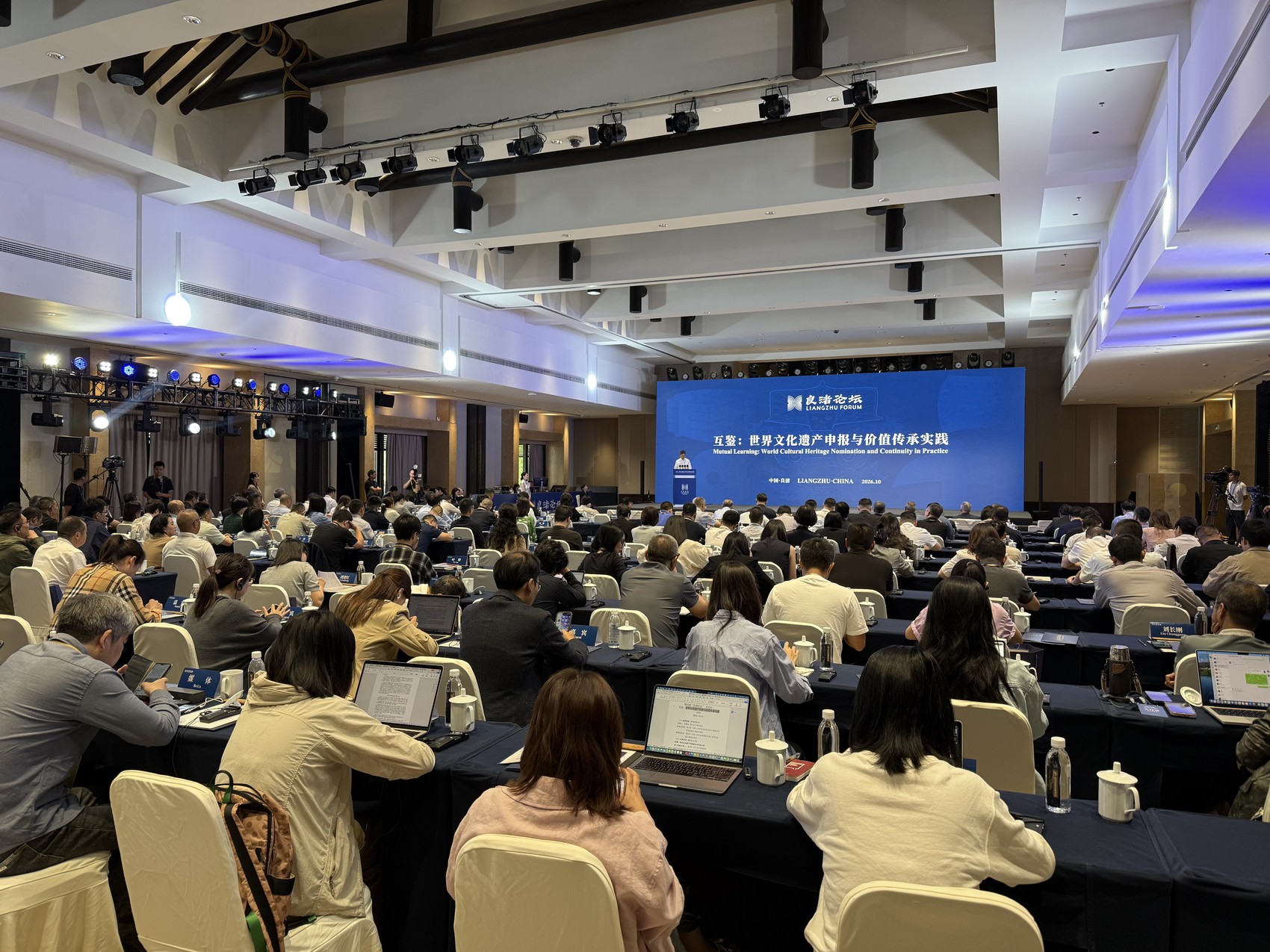
Scene at the Sub-forum on Mutual Learning: Practices in World Cultural Heritage Nomination and Continuity in Practice
"Mutual learning is vital because heritage is a transnational endeavor," Pearson emphasized. Luisa De Marco, a cultural heritage advisor at ICOMOS, echoed this sentiment, noting that heritage is a common concern for all humanity, and its comprehensive protection is likewise a shared responsibility. Pearson further explained that "mutual learning" implies that principles of cultural heritage conservation across nations can be mutually referenced and resonate with one another, a practice of profound significance given the continuous flow of knowledge.
Zhang Zhe, a research fellow at the Zhejiang Institute of Ancient Architectural Design and Research, added that countries vary in national conditions and development stages, resulting in diverse challenges in heritage protection and management, with each heritage site undertaking its own explorations. Citing his research on wooden arch corridor bridges in Fujian and Zhejiang provinces as an example, he noted that the focus lies in exploring how to collaborate with local communities to advance conservation and transmission. Therefore, learning from the best practices of other countries constitutes a key component of mutual learning.
As a former special advisor to the director-general of ICCROM, Gamini Wijesuriya believes that countries can share knowledge through exchanges and gain insights into how other nations, including China, approach heritage. This process represents not merely one-way communication but rather co-creation. Qiao Yunfei, deputy director of China's National Cultural Heritage Administration, stated that China has achieved a globally leading position in conceptual exploration and practical innovation regarding world cultural heritage conservation. However, international understanding of these efforts remains insufficiently comprehensive and in-depth. He emphasized the need for a more proactive approach to "going global and bringing in" expertise, actively implementing the Global Civilization Initiative, deepening cooperation with international organizations, jointly participating in rule-making, and promoting the advancement of conservation philosophies and technological innovation.
【本篇文字部分内容由 AI 辅助写作,特此声明。Please note: the text in this article was created with the help of AI.】
