
Chengdu-Chongqing Expressway: First Bridge Joins, 2028 Completion Set
2026-10-15 17:45:32 by Queenie Tan
On Oct. 15, the mid-span closure section of the Yanghua River Bridge, part of the Chengdu-Chongqing Expressway Expansion Project, was successfully poured, making it the first rigid-frame bridge along the entire route to achieve closure. This milestone marks the project's official transition to the construction phase of the bridge deck system and auxiliary facilities, shifting engineering operations from "segmented advancement" to "continuous operations", thereby providing solid support for the completion of the entire route by the end of 2028.
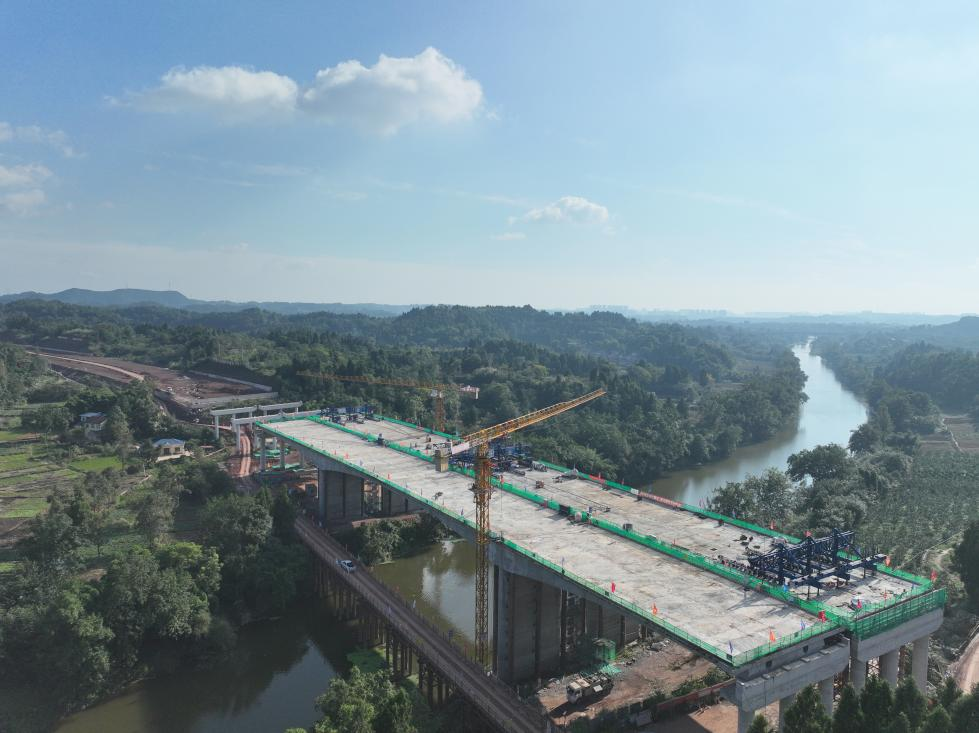
On-site construction photo of the Yanghua River Bridge
Located in Baohe Town, Yanjiang District, Ziyang City, the Yanghua River Bridge is a critical control project of the Chengdu-Chongqing Expressway Expansion Project. Designed with dual-directional eight lanes, the bridge has a total length of 332.96 meters and a height of 22.42 meters.
As a dual-directional eight-lane bridge, its beam segments require large volumes of concrete per pour and extended periods of continuous operation, making construction akin to erecting a giant "steel skeleton" tens of meters above the ground. The structural system conversion procedures for the entire bridge are closely interlinked, and even minor deviations could directly affect the final alignment and structural safety. Furthermore, as the bridge spans the Yanghua River and passes near critical water intake points, strict adherence to ecological protection red lines is required throughout construction to preserve the river's water quality.
Facing these technical challenges, the project team implemented a comprehensive set of measures to overcome the difficulties. According to relevant officials, relying on an intelligent real-time monitoring system for stress and alignment, the team conducted round-the-clock dynamic monitoring of temperature fluctuations in the closure section, beam balance status, and elevation changes at cantilever ends, achieving closed-loop management across the entire process of "monitoring, analysis, and adjustment".
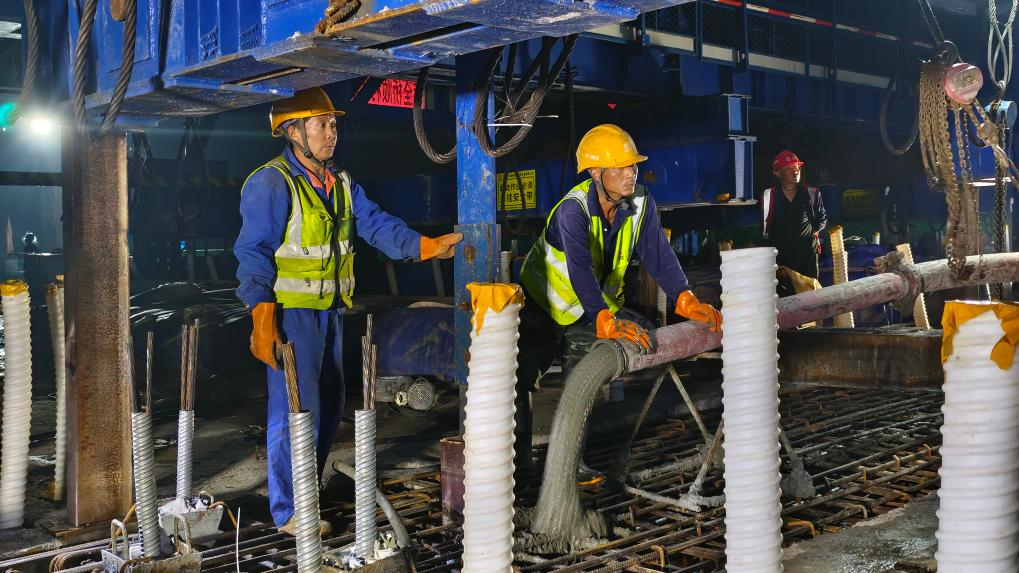
On-site construction photo of the Yanghua River Bridge
The Chengdu-Chongqing Expressway Expansion Project is being advanced in three sections: Chengdu, Ziyang, and Neijiang. To date, subgrade formation in parts of Ziyang and Neijiang is largely complete, and bridge foundations have been substantially finished; work is steadily progressing on beam prefabrication and installation, remaining earthworks, and auxiliary facility construction. The Chengdu section focuses on widening and new construction on both sides of the existing expressway, with intensive efforts underway for subgrade works, bridge widening, and reconstruction of existing ramps. Key control projects along the entire route, including the Longquanshan Tunnel, Tuojiang Grand Bridge, and Zhonghe Hub, are also advancing in an orderly manner.
Led by Shudao Group for investment and construction, the route begins at the Sichuan-Chongqing boundary at Sangjiapo in Neijiang City, connecting to the ongoing expansion of the G85 Yinkun Expressway Chongqing section. It passes through Longchang, Dongxing, and Zizhong in Neijiang; Yanjiang in Ziyang; and Jianyang in Chengdu, terminating at Gaodong in Chengdu to link with the completed East-West Axis of Chengdu. The total length of the project is approximately 290 kilometers, comprising about 190 kilometers in Sichuan and 100 kilometers in Chongqing, with the estimated total investment for the Sichuan section reaching 49.76 billion yuan. Adopting a combined approach of partial realignment with new construction and expansion of the existing road, the project is designed as a dual-directional eight-lane expressway with a design speed of 100 to 120 kilometers per hour, increasing traffic capacity to 100,000 vehicle trips per day.
The entire route is expected to open to traffic by the end of 2028. Upon completion, it will enable direct travel between the twin cores of Chengdu and Chongqing within two hours, reducing travel time by approximately one hour compared to existing routes.
【本篇文字部分内容由 AI 辅助写作,特此声明。Please note: the text in this article was created with the help of AI.】
