
Sichuan's 15th Five-Year Plan: From Pollution Control to Beauty
2026-10-14 12:01:32 by Queenie Tan
On October 13, the Information Office of the Provincial Government held a press conference titled "Sichuan's Vibrant Development: Embarking on the 15th Five-Year Plan", to interpret the plan for building a Beautiful Sichuan during the 15th Five-Year Plan period (2026-2030). Reviewing the 14th Five-Year Plan period, Sichuan consolidated its role as an ecological barrier in the upper reaches of the Yangtze and Yellow rivers, coordinating efforts in carbon reduction, pollution control, green expansion, and economic growth. As a result, the province's eco-environmental quality has reached its best level in nearly two decades.
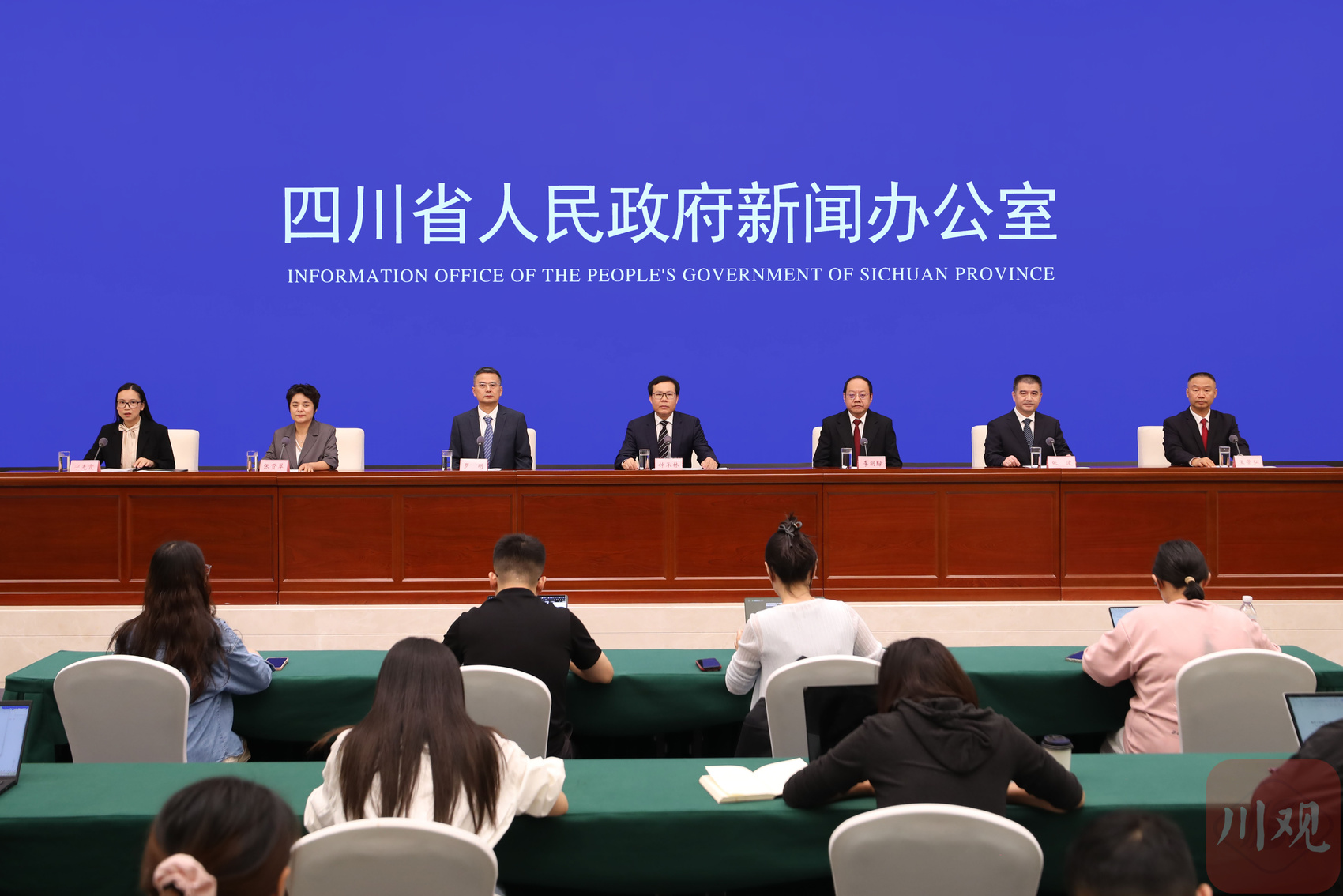
Press Conference Venue
Looking ahead to the 15th Five-Year Plan period, Sichuan will place greater emphasis on a people-centered approach, coordinate protection with development, focus on ecological empowerment, and elevate governance from "pollution prevention and control" to "comprehensively advancing Beautiful China initiatives". Zhong Chenglin, Director of the Provincial Department of Ecology and Environment, explained that the goal is to enjoy both "magnificent landscapes" and "a beautiful daily life", noting that a three-dimensional ecological pattern stretching from snow-capped mountains to basins has essentially taken shape.
New Transformation
Ecological governance shifts from "remediation" to "enhancement".
Comparing the old and new plans, the transition from a five-year plan for eco-environmental protection to one for building a Beautiful Sichuan sends a new signal. Zhong Chenglin stated that this marks a new stage in the work, requiring new adjustments and transformations.
The transformation lies in the fact that prominent environmental issues, which were the primary focus in the past, are now effectively under control, with quality continuing to improve. Taking water governance as an example, the scope has expanded from major rivers and streams—the "arteries"—to ponds and ditches—the "capillaries".
To drive a systematic leap, the Plan takes comprehensively advancing the building of a Beautiful Sichuan as its overarching theme, promoting all-sector transformation, all-round improvement, region-wide construction, and whole-of-society participation. Benchmarking against the standards of "external beauty, internal elegance, and excellent character", it coordinates efforts in carbon reduction, pollution control, green expansion, and economic growth.
Zhong Chenglin explained that this transformation is reflected in four aspects: shifting from a focus on pollution prevention and control to comprehensively advancing Beautiful China initiatives; shifting from a focus on ecological supervision to placing greater emphasis on ecological empowerment; shifting from a focus on compliance management to prioritizing a people-centered approach; and shifting from a focus on factor security to systemic security.
To support this transformation, Sichuan has reserved 497 major projects with a total investment of nearly 226 billion yuan, providing strong backing for the implementation of the Plan.
In terms of execution, targeting the 2035 goals, the Plan proposes that significant progress be made in building a Beautiful Sichuan by 2030, with pilot zones achieving landmark results and the ecological security barrier becoming more robust. It outlines deployments in four areas: improving environmental quality, advancing green and low-carbon transformation, safeguarding bottom lines, and enhancing efficiency, encompassing 20 indicators, 29 tasks, and major projects. By the end of the 15th Five-Year Plan period, the proportion of beautiful cities is expected to reach 60%, the completion rate of beautiful rivers and lakes 65%, and 110 counties will have fully established beautiful villages.
New Experience
Beyond meeting data targets, making "beauty" part of the public's everyday life.
In the past, effectiveness was largely measured by data. During the 15th Five-Year Plan period, Sichuan will shift its focus from "data" to "people", emphasizing not just "statistics" but also "lived experience".
Zhong Chenglin noted that a "beautiful daily life" is reflected in addressing practical concerns at people's doorsteps, extending governance to streets, communities, and villages. He summarized that during the 15th Five-Year Plan period, "clear waters and green banks" will become commonplace, clean "vibrancy of daily life" will be the norm, peaceful living will be standard, and "zero-waste" practices will be routine.
Specifically, Sichuan will focus on issues such as abnormal water bodies, foul odors, and floating garbage, expanding governance from main channels to capillary networks and shifting priorities from urban centers to counties and townships. The province plans to complete the remediation of over 100 rural rivers and lakes by the end of 2027. By 2030, local water bodies are expected to be basically free of black odors, surface scum, and illegal sewage outfalls, meeting new public demands for water accessibility.
Meanwhile, precise governance will target cooking fumes and other aspects of urban vibrancy. Commercial layouts will be optimized, oil fume purification facilities will be upgraded in a categorized manner, automatic online monitoring systems will be deployed more rapidly, and key cities will be connected to a unified network.
Addressing noise disturbances, the province will adhere to source prevention and control, establish comprehensive governance lists, and precisely manage industrial, construction, transportation, and social life noise to restore tranquility for residents.
Furthermore, "zero-waste" practices will become part of daily life. Five special rectification campaigns for solid waste will be launched to address issues such as illegal dumping. The "Zero-Waste City" initiative will be enhanced and expanded to cultivate more "zero-waste cells".
New Development
Making environmental protection an "accelerator" for industrial upgrading, technological innovation, and model transformation.
Since the beginning of the 14th Five-Year Plan period, Sichuan has pursued reforms while strictly observing red lines, exploring solutions to development challenges.
Zhong Chenglin introduced that focusing on enhancing ecosystem diversity, stability, and sustainability, adapting to climate change, and strengthening supervision, the Plan has mapped out six key projects, including biodiversity conservation and risk management. It specifies that by 2030, the foundation of the three major ecological barrier zones will be more solid, creating a more harmonious and secure ecological home.
With bottom lines firmly secured, confidence in development grows stronger. During the 15th Five-Year Plan period, Sichuan will balance its "environmental accounts" and "development accounts". The Plan proposes that a spatial pattern for green, low-carbon, and high-quality development be basically established by 2030, with deployments to prudently advance carbon peaking and optimize industrial, energy, and transportation structures.
Additionally, focusing on source prevention, regulatory guidance, and market incentives, the Plan proposes concrete measures such as improving zoned management and control, optimizing law enforcement, and deepening reforms in the market-based allocation of production factors.
Entering the 15th Five-Year Plan period, Sichuan will leverage the optimizing and supporting role of ecological and environmental protection to open up pathways for transforming "lucid waters and lush mountains" into "gold and silver mountains," converting ecological advantages into developmental strengths, and making environmental protection a true "accelerator" for industrial upgrading, technological innovation, and model transformation.
【本篇文字部分内容由 AI 辅助写作,特此声明。Please note: the text in this article was created with the help of AI.】
