
Two giant pandas arrive in Atlanta, U.S.
2026-09-29 17:18:20 by Queenie Tan
Ping Ping and Fu Shuang Arrive in Atlanta, U.S.; Local Residents: "Can't Wait to See the Pandas!"
With the arrival of two giant pandas in Atlanta, United States, a 25-year "panda bond" has been renewed.
On Sept. 27 local time, Chinese giant pandas "Pingping" and "Fushuang" arrived at Hartsfield-Jackson Atlanta International Airport aboard a flight and were subsequently transferred to Zoo Atlanta. According to arrangements made by China and the United States, the pair, hailing from the Chengdu Research Base of Giant Panda Breeding, will begin a 10-year residency here and participate in a new round of international cooperation on giant panda conservation.
"This is a thrilling day for Zoo Atlanta and a historic moment for the City of Atlanta, the state of Georgia, and beyond," Zoo Atlanta President and CEO Raymond B. King said in a statement. He noted that the zoo is thrilled to welcome Ping Ping and Fu Shuang and looks forward to sharing this joy with members, visitors, and the community in the coming weeks.
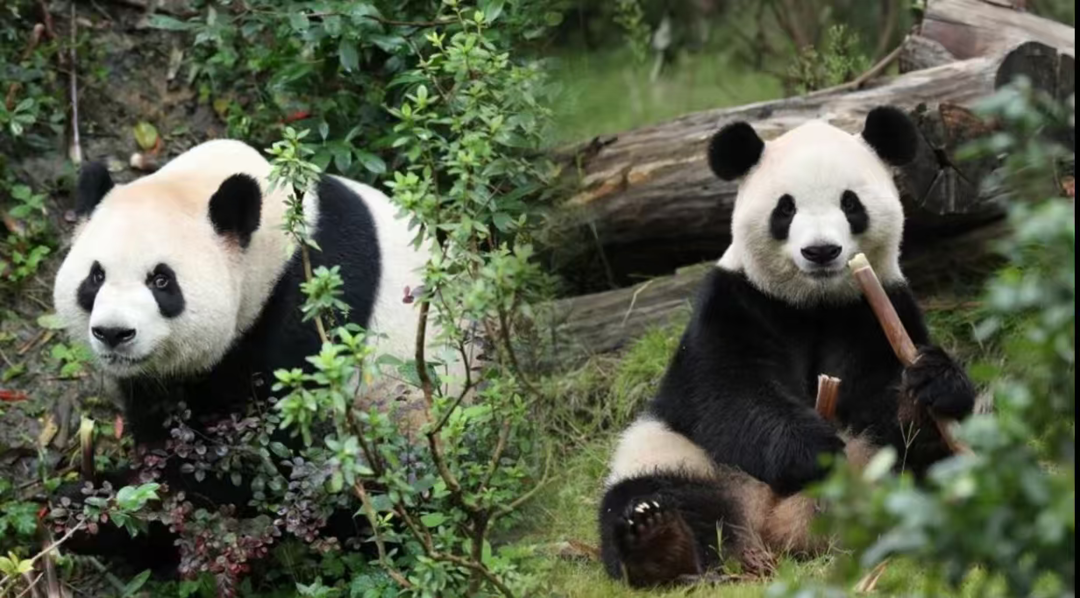
Ping Ping and Fu Shuang (Photo source: Xinhua)
However, for Ping Ping and Fu Shuang, having just crossed the Pacific Ocean, this new journey has only just begun.
Upon arrival, the two pandas entered the new giant panda habitat at Zoo Atlanta to undergo a standard quarantine period of approximately one month. Veterinarians and keepers from China will be stationed at the zoo to care for them, conducting stress adaptation and behavioral training to help them gradually acclimate to their new living environment. Zoo Atlanta also stated that the exhibit will not open to visitors immediately, and the official public debut date will be announced at a later time.
A Transpacific Panda "Relocation"
For giant pandas, long-distance international transport is no ordinary journey.
Ping Ping is a male born on March 17, 2020; Fu Shuang is a female born on Oct. 18, 2020. Both pandas were born at the Chengdu Research Base of Giant Panda Breeding. Prior to their departure for the United States, the Chinese side had conducted transport adaptation training in advance and arranged for veterinarians and keepers to travel to Atlanta to make preparations.
On Sept. 27, the two pandas departed from Chengdu aboard a dedicated charter plane and arrived in Atlanta after a long-haul flight. Upon landing, veterinarians and keepers from both China and the United States immediately conducted a joint examination, confirming that both pandas are in good health. They were then transferred to the zoo to begin the quarantine phase.
Behind this lies a highly meticulous transnational collaboration. Before the pandas' arrival, Zoo Atlanta had already upgraded its existing facilities. In July, a TheCover reporter visited Zoo Atlanta and noted that information released by the zoo indicated the expanded and renovated new giant panda habitat would provide more comprehensive activity and living spaces for the animals.
For the zoo, this was not simply a matter of reopening old facilities. In April, when Zoo Atlanta announced the launch of a new international cooperative research agreement on giant panda conservation with the China Wildlife Conservation Association, President Raymond B. King stated that the zoo was deeply honored to once again undertake giant panda conservation work and looked forward to continuing conservation and research collaboration with the Chinese side.
After extensive preparation, Ping Ping and Fu Shuang have finally become the new residents of this facility.
From Lun Lun and Yang Yang to Ping Ping and Fu Shuang
For Zoo Atlanta, this is not the first time giant pandas have graced the institution. In 1999, Lun Lun and " Yang Yang arrived in Atlanta, initiating a 25-year partnership on giant panda conservation between the local institution and China. Over the subsequent 25 years, the two sides engaged in sustained cooperation covering giant panda breeding, husbandry, disease prevention and control, and scientific research.
This partnership has yielded a remarkable "report card". According to information released by Zoo Atlanta, during the cooperation period from 1999 to 2024, Lun Lun and Yang Yang produced five litters totaling seven surviving cubs.
In October 2024, as the previous cooperation agreement expired, Lun Lun, Yang Yang, and their two cubs, Ya Lun and Xi Lun, returned to Chengdu. Subsequently, Zoo Atlanta experienced a period without giant pandas for the first time in 25 years of hosting the species.
This change even impacted the zoo's operations. Raymond B. King revealed in a previous interview that Zoo Atlanta's attendance approached 1 million in 2024 but dropped below 900,000 in 2025. He attributed part of this decline to the departure of the giant pandas, though economic conditions and weather may also have played a role.
Now, the giant pandas have returned. Yet in Raymond B. King's view, the significance of the pandas clearly extends beyond attracting visitors. He stated in a previous interview that giant panda conservation represents one of the zoo's largest conservation investments and stands as a successful example of global cooperation in addressing endangered species protection. Over the past 25 years, Zoo Atlanta has invested approximately $17 million in giant panda conservation efforts in China, funding initiatives such as habitat restoration, nature reserve management, and support for rangers.
Zoo Atlanta official website.
This explains why "conservation" and "scientific research" have been repeatedly emphasized in this new partnership. Under the new international cooperative research agreement, Zoo Atlanta will continue to collaborate with the China Wildlife Conservation Association on giant panda conservation. Zoo Atlanta officials stated that a key objective of this partnership remains giant panda conservation, while also continuing the long-standing bilateral cooperation in professional husbandry, research, and information exchange.
Ten Years Is Just the Beginning: How Far Can Panda Cooperation Go?
From 1999 to 2024, and now to 2026 with the arrival of Ping Ping and Fu Shuang in Atlanta, Sino-US giant panda cooperation has spanned 25 years.
While the pandas themselves have changed, what endures is the human-to-human collaboration built around shared conservation goals.
Over the past 25 years, staff at Zoo Atlanta and their Chinese counterparts have accumulated extensive experience in giant panda husbandry, breeding, and health management. As this new round of cooperation begins, this expertise will serve as a vital foundation for helping Ping Ping and Fu Shuang adapt to their new environment.
For the general public, giant pandas remain the most visible aspect of this effort. Less visible, however, is the comprehensive system of scientific research, husbandry, breeding, habitat conservation, and public education that has been progressively established around wildlife protection.
According to Zoo Atlanta's official website, giant pandas are currently listed as "Vulnerable" on the International Union for Conservation of Nature (IUCN) Red List, and previous collaboration between the zoo and Chinese counterparts has encompassed areas such as habitat restoration and nature reserve management. Raymond B. King has also expressed a longer-term aspiration: although the current agreement is initially set for 10 years, he hopes it can be extended just as previous agreements were.
