
New Findings Reveal Rituals Behind Sichuan's Sanxingdui Pits
2026-09-24 16:20:17 by Queenie Tan
On September 23, four new findings from multidisciplinary research on Sanxingdui and Jinsha were released at the Cultural Exchanges between Sanxingdui-Jinsha Sites and Surrounding Areas professional salon held in Beijing. These findings collectively highlight research progress on cultural exchanges between the ancient Shu civilization, represented by Sanxingdui and Jinsha, and the Central Plains as well as neighboring regions. They address numerous key questions in the study of the ancient Shu civilization and provide significant archaeological support for interpreting the pluralistic and integrated pattern of Chinese civilization. Notably, this event served as a key component of the professional salons of the 2026 Beijing Culture Forum.
In tracing the origins of Chinese civilization, what role did the Ba-Shu region in the upper reaches of the Yangtze River play? Professor Huo Wei of Sichuan University presented a paper titled On the Contribution of Ba-Shu Civilization to the Origin of Chinese Civilization, which outlined the complete archaeological sequence from the Piluo site and Baodun culture to Sanxingdui and Jinsha, analyzing the developmental path of Ba-Shu civilization that was both inclusive of diverse influences and distinctly unique.
The study suggests that Ba-Shu civilization, as a vital representative of civilization in the upper Yangtze River, enriches the historical narrative of Chinese civilization characterized by a "starry sky" of diverse regional cultures.
Sanxingdui is one of the core sites of the ancient Shu civilization, and its 8 sacrificial pits serve as crucial evidence for interpreting the ritual system of ancient Shu. Why were these eight pits buried? What was the complete burial process? A series of mysteries have captured widespread public attention.
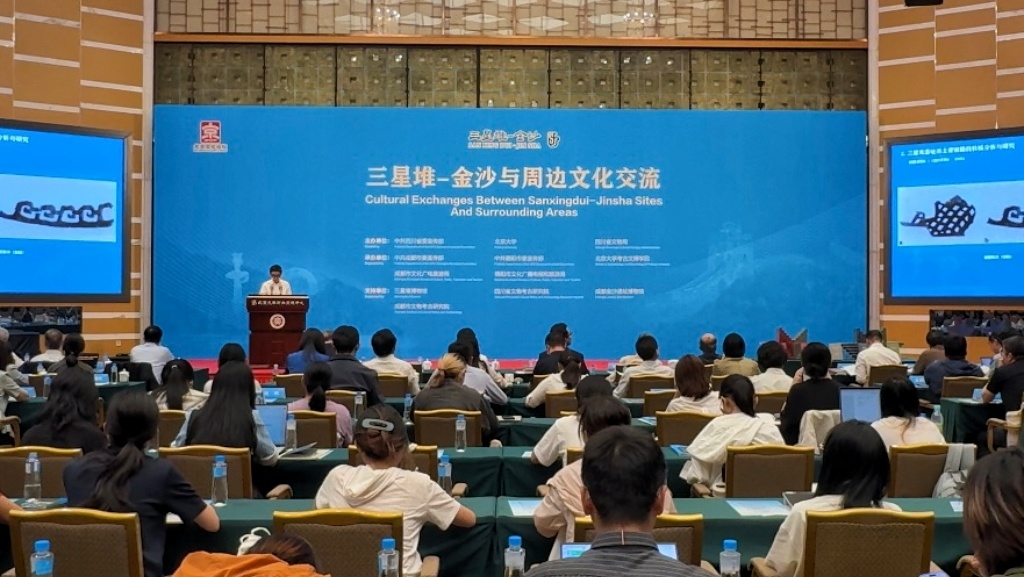
At the Event Venue
Research indicates that while the eight pits share similar contexts, they exhibit variations in ritual details, reflecting the diversity of sacrificial practices in ancient Shu.
Regarding the sacrificial pits, Zhao Hao, a researcher at Peking University, presented a paper titled Analysis of the Formation Process and Contextual Speculation of the Sanxingdui Artifact Pits. Integrating clues such as pit layout, cross-pit artifact refitting, and artifact storage distribution, he proposed that the eight pits resulted from a meticulously planned, multi-phased major ritual event. He suggested that this ritual may have been linked to the dynastic transition from the Shang to the Zhou, a conclusion that complements and corroborates the findings of Zhang Junna's team.
Artifacts unearthed from the Sanxingdui sacrificial pits have drawn significant attention. A team led by Guo Jianbo from the Sichuan Provincial Institute of Cultural Relics and Archaeology published a paper presenting scientific analyses of fish-shaped, zhang-shaped, and leaf-vein-patterned bronze foils. The study confirmed that these foils were all formed by hammering and decorated using techniques including incising, punching, pressing, and painting, with holes created by percussion. The incising technique may represent an early stage of engraving craftsmanship, providing key evidence for studying the hammered copper handicraft industry of the ancient Shu period.
Cultural relic conservation is also a critical component of research on the ancient Shu civilization. Relying on the National Key Research and Development Program, a team led by Xiao Lin from the Chengdu Institute of Cultural Relics and Archaeology has established a comprehensive, integrated technical system for conserving fragile waterlogged ivory unearthed from the Sanxingdui and Jinsha sites. This system covers the entire workflow, including mechanism research, on-site emergency conservation, laboratory consolidation, effectiveness evaluation, and long-term maintenance. It features two innovatively developed core technologies—chemical material consolidation and in-situ microbial consolidation—and establishes standardized protocols for moisture retention, mold prevention, and non-destructive extraction at excavation sites. This achievement resolves previous issues of fragmented techniques and lacking standards in waterlogged ivory conservation. Consolidated ivory can now be directly used for museum exhibitions, marking a scientific and standardized breakthrough in the conservation of organic cultural relics.
Recently, multidisciplinary archaeological research on Sanxingdui and Jinsha has yielded a succession of significant findings. Provenance tracing of red carnelian beads unearthed at Sanxingdui confirms long-distance material exchange between the ancient Shu state and the northern steppe regions. Scientific analysis of bronzes reveals technical characteristics of localization and integration after typical artifacts from the Central Plains and other regions were introduced to ancient Shu. Paleoethnobotanical research at the "Huangzhong Primary School" locality of the Jinsha site has extended the research scope to residential settlements, reconstructing the agricultural production and staple food structure of ancient inhabitants.
From long-distance trade and handicraft technologies to daily production and life, these interdisciplinary findings continue to complete the puzzle of the ancient Shu civilization, consistently enriching the archaeological evidence for the pluralistic and integrated pattern of Chinese civilization.
【本篇文字部分内容由 AI 辅助写作,特此声明。Please note: the text in this article was created with the help of AI.】
