
Airbus Forecasts 8,830 New Jets for China as Sichuan Supply Chain Expands
2026-09-09 16:31:18 by Queenie Tan
On September 8, Airbus held a media briefing in Beijing on its Global Market Forecast. The latest forecast indicates that over the next two decades, China will require 8,830 new passenger aircraft, accounting for more than 20% of total global demand during the same period. Xu Gang, Airbus Global Executive Vice President and CEO of Airbus China, stated that China is the cornerstone of the global aviation market and remains Airbus' largest single-country market.
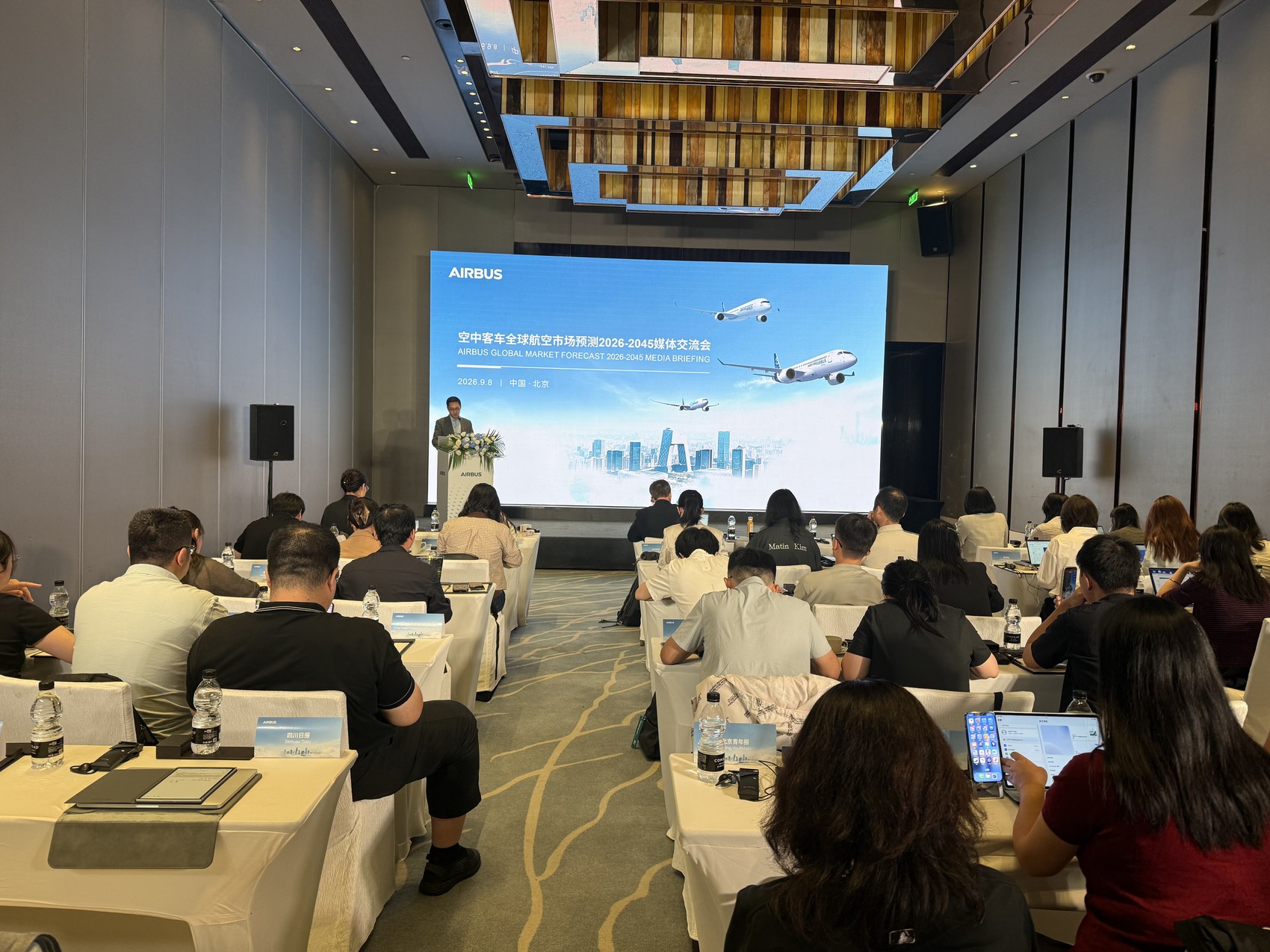
Airbus Exchange Event
Regarding Airbus' strategic deployment in Sichuan province, Wang Cui, Airbus Global Senior Vice President and Head of Commercial Aircraft Business at Airbus China, responded that Airbus has been deeply engaged in Sichuan, with its industrial chain layout advancing steadily.
Since the beginning of this year, affected by geopolitical tensions and macroeconomic conditions, rising jet fuel prices and the cancellation of certain routes have led to a trend of "revenue growth without profit growth" in China's domestic civil aviation sector during the first half of the year; however, the industry's resilience remains robust. From January to July, China's civil aviation sector carried a cumulative total of 450 million passengers, up 1.5% year-on-year, while revenue passenger kilometers increased by 4.6% compared to the same period last year.
Driven by an expanding middle class and ongoing urbanization, airlines continue to expand their route networks. Airbus forecasts that China's air passenger traffic will rise at a compound annual growth rate of 5.2%, increasing from 1.7 trillion revenue passenger kilometers in 2025 to 4.6 trillion in 2045. Annual per capita air trips are projected to grow from 0.5 to 1.4.

Various models of Airbus aircraft
Industry development expectations translate directly into demand for new aircraft. By 2045, China's in-service passenger fleet is expected to grow to 9,860 aircraft. To meet this demand, China will need 7,480 new single-aisle aircraft and 1,350 new widebody aircraft. Nearly half of these new deliveries will be used for fleet expansion, while more than 30% will replace aging models.
Addressing competition between civil aviation and railways, the head of Airbus' Global Market Forecast noted that due to China's extensive high-speed rail network, passenger transport modes show clear segmentation based on distance: road travel dominates short distances, rail accounts for a high share of medium-distance travel, and civil aviation regains the advantage for journeys exceeding 1,200 kilometers. The 800-to-1,500-kilometer range represents a sensitive zone of competition between air and rail.
The executive observed that high-speed rail diverts some passenger traffic from short- and medium-haul trips under three hours, resulting in annual growth rates of only 1% to 3% for routes under 700 kilometers, whereas long-haul routes exceeding 1,000 kilometers are growing at 7% to 10%. Overall, approximately 10% of the aviation market has shifted to high-speed rail, with another 10% expected to shift in the future. However, high-speed rail and civil aviation remain complementary, and this dynamic does not impede the overall growth of domestic aviation.
The Chengdu-Chongqing region presents a noteworthy case study. Data shows that during this year's summer travel peak, civil aviation accounted for 5.6% of passenger traffic in the 300-to-800-kilometer segment within the Chengdu-Chongqing area, the highest among China's four major economic clusters, partly due to mountainous terrain limiting high-speed rail speeds. Leveraging its geographic location in southwest China and its status as a transportation hub, Chengdu recorded a civil aviation market share of 10.7%, significantly above the national average.
The Chengdu aviation hub has established the densest route network in central and western China, leading the region in coverage breadth and extending its reach to Central Asia, Europe, the Americas, and other destinations. During the summer travel season, its passenger throughput ranked third among all Chinese cities.
Currently, Airbus is building a full-industry-chain ecosystem in China. The Airbus Aircraft Full Lifecycle Service Center, located in Chengdu, is the company's first such facility outside Europe, offering "one-stop" services including parking, maintenance, and dismantling. With a total investment of 6 billion yuan, the project was signed in April 2022, completed and put into operation within 14 months, and has now been operational for more than two years.
Wang Cui stated that the project has received strong support from local authorities and aims to meet world-leading standards, enabling 91% of aircraft weight to be recycled. As of June 2026, it has served more than 30 clients worldwide and processed over 70 aircraft.
Furthermore, Airbus has forged deep ties with customers in Sichuan. Sichuan Airlines, Tibet Airlines, and Chengdu Airlines are all key clients, with Sichuan Airlines becoming the largest operator of an all-Airbus fleet in China. On the supply chain front, Airbus has established the Huaou Aviation Training Base through a joint venture with China Aviation Materials, and engages in extensive cooperation with the Civil Aviation Flight University of China in training and other fields. Wang Cui emphasized that Airbus is making steady progress in Sichuan across both industrial chain deployment and supplier development.
【本文部分内容由AI辅助生成,特此声明。The author(s) generated part of the content in this work with the assistance of artificial intelligence (AI), which is hereby declared.】
