
Taiwan Youth Explore Sichuan's Ancient Sites and Opera
2026-08-07 16:11:41 by AIOS
On July 27, the Journey Around Sichuan event for Taiwan youth kicked off in Ziyang. Forty participants from Taiwan, including students, cultural professionals, media reporters, and business representatives, visited the Mengxihe Site, the Anyue Grottoes Digital Exhibition Center, and the Lezhi County Study Tour Center, embarking on an immersive cultural experience.
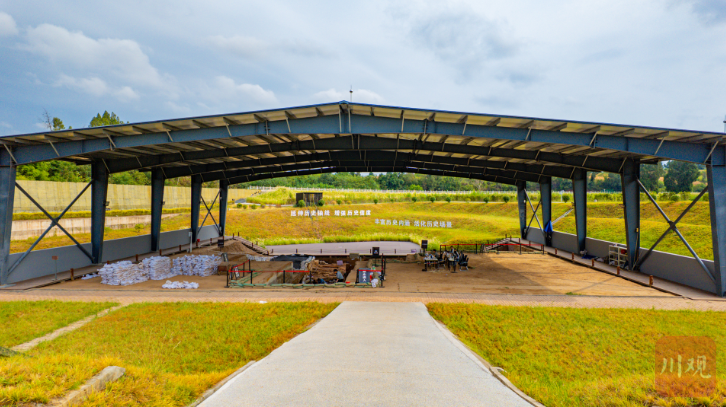
The archaeological shelter at the Mengxihe site
Located in Lezhi County, the Mengxihe Site is regarded as an "encyclopedic" Paleolithic site that fills a critical gap in understanding the "evolutionary bottleneck of modern humans in East Asia." The guests toured the site complex, archaeological shelters, and a micro-museum.
Mr. Zhang, a university student from Taiwan who had originally expected to see giant pandas, gained unexpected insights: "I learned that tools used by humans tens of thousands of years ago were not limited to stone implements but also included bone and wooden artifacts."
During the 2021 flood season, floodwaters exposed buried ebony wood and animal fossils, prompting a rescue excavation. After his visit, Mr. Liao, a scholar from Taiwan, remarked, "Sichuan has devoted tremendous effort to cultural preservation, which is truly impressive and has given me an entirely new perspective on Sichuan's culture."
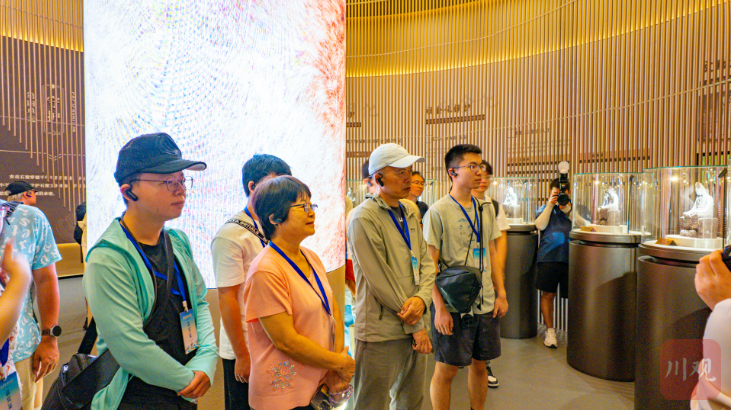
Guests from Taiwan visited the Anyue Grottoes Digital Exhibition Center for a tour and interactive experience
The delegation then proceeded to the Anyue Grottoes Digital Exhibition Center. Leveraging digital technology, local authorities have transformed more than 500 cliffside sculptures into interactive digital representations, ensuring their perpetual preservation in virtual space. Ms. Chen, a university student from Taiwan, noted, "Being able to view such lifelike stone carvings indoors creates a powerful sense of immersion through technology."
The Anyue stone carvings are renowned for being "ancient, numerous, exquisite, and beautiful". Coinciding with the summer vacation, Mr. Xu and his wife brought their children along from Taiwan. The digital displays and 3D dome theater captivated the young visitors. Mr. Xu observed, "The ingenious fusion of ancient art and modern technology demonstrates that Chinese culture is not only historically profound but also possesses immense aesthetic appeal, which is truly awe-inspiring."
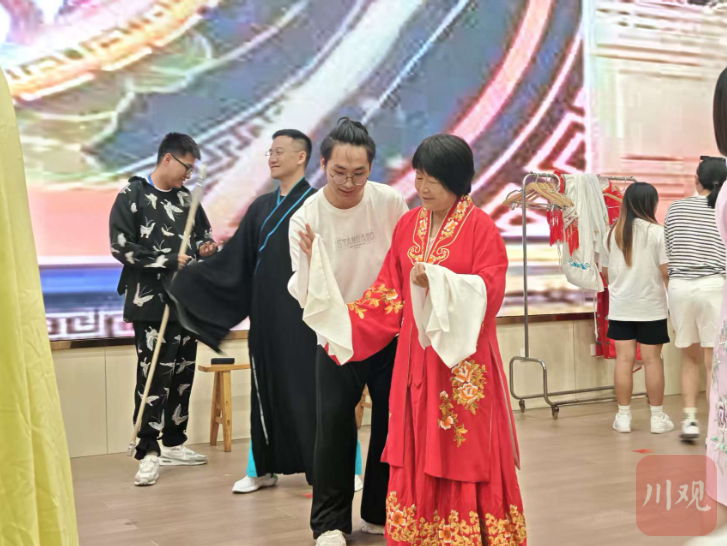
At the Cross-Strait Quyi Exchange Conference, professionals instructed guests in stylized movements.
That afternoon, a cross-strait folk art exchange held at the Lezhi County Study Tour Center brought the atmosphere to a climax. The "Ziyang River" school is the only one among the four major regional schools of Sichuan Opera named after a prefecture-level city. Originating in the Tuojiang River basin of Ziyang and taking shape during the Ming and Qing dynasties, it boasts a lineage spanning nearly 300 years and is distinguished by its high-pitched vocal style. Guests enjoyed close-up performances of signature techniques such as face-changing and fire-breathing, and under professional guidance, tried on opera costumes and practiced stage movements. Ms. Huang, visiting the Chinese mainland for the second time, was in high spirits and expressed great satisfaction with the itinerary: "Experiencing local customs and culture without arduous travel was unexpectedly wonderful.".
【本文部分内容由AI辅助生成,特此声明。The author(s) generated part of the content in this work with the assistance of artificial intelligence (AI), which is hereby declared.】
