
Scholars Gather in Sichuan to Unveil Latest Findings on Sanxingdui After 40 Years
2026-07-24 11:50:42 by AIOS
Between July and September 1986, Sacrificial Pits No. 1 and No. 2 at the Sanxingdui site in Guanghan, Sichuan, were successively unearthed, awakening the ancient Shu civilization—dormant for thousands of years—and astonishing the world.
On July 24, marking the 40th anniversary of the excavation, an academic symposium commemorating the 40th anniversary of the discovery of the Sanxingdui sacrificial pits and focusing on research and conservation of ancient ivory was held in Guanghan. Over the two-day conference, more than 100 scholars and experts from China and abroad gathered to unveil the latest findings in Sanxingdui archaeological research.
The conference centered on two main themes: comprehensive archaeology of Sanxingdui and specialized research on ancient ivory, bringing together leading scholars from multiple disciplines including archaeology, cultural heritage conservation, and paleobiology.
Participants systematically reviewed four decades of field excavations and interdisciplinary research, engaging in discussions on core topics such as the urban layout of the ancient Sanxingdui city, the nature and content of the sacrificial pits, bronze craftsmanship technologies, and interregional civilizational interactions. They also delved into cutting-edge issues concerning ancient ivory, including provenance tracing, processing techniques, ritual functions, and conservation against deterioration, thereby deepening the understanding of the ancient Shu civilization through an interdisciplinary lens, refining the conservation framework for ancient ivory, and enhancing its international visibility and academic influence.
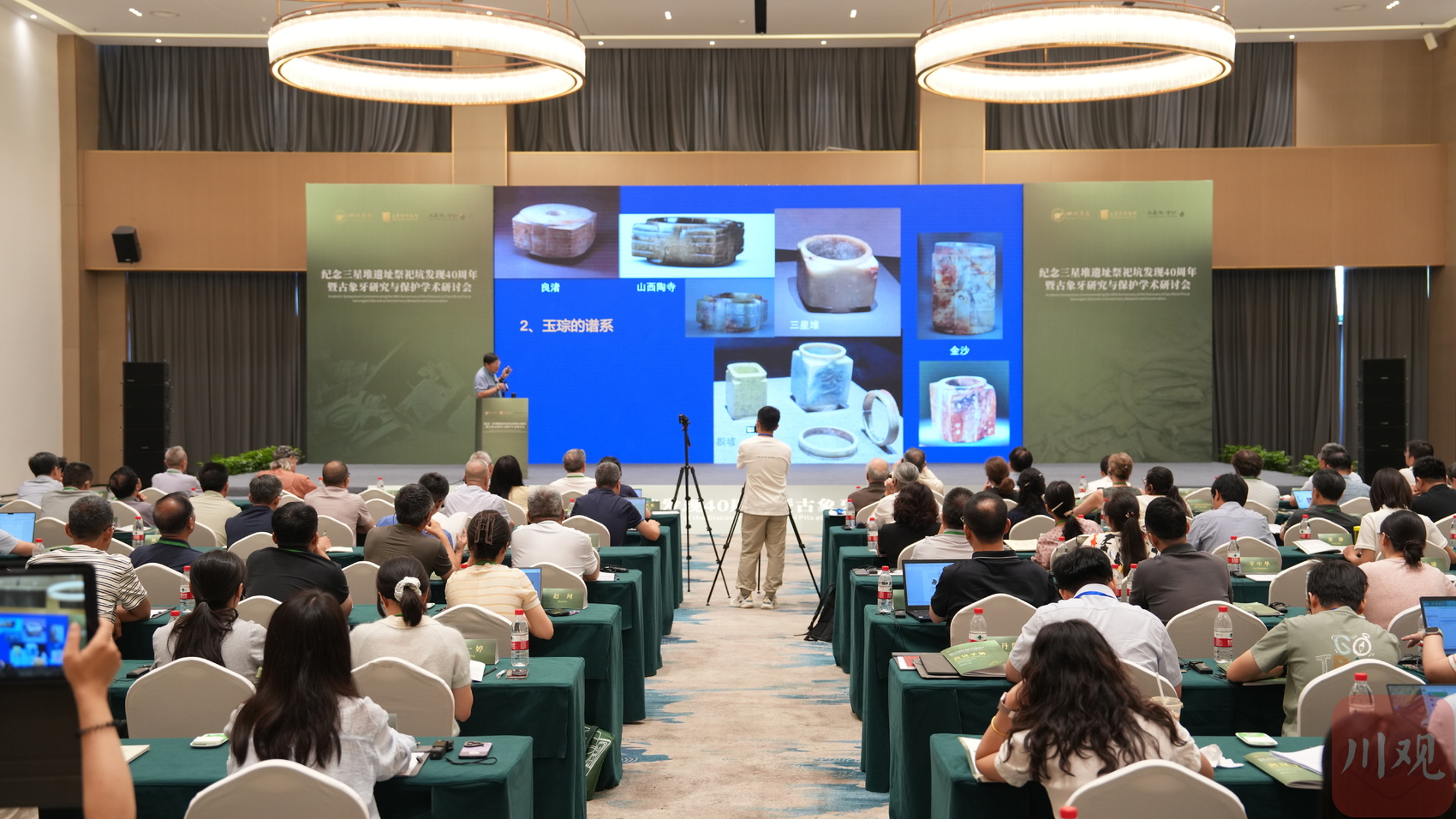
The seminar venue
At the conference, Wang Wei, an academician of the Chinese Academy of Social Sciences; Rowan Flad, professor at Harvard University; Daniel Fisher, emeritus professor at the University of Michigan; and Ran Honglin, a researcher at the Sichuan Provincial Cultural Relics and Archaeology Research Institute, delivered keynote speeches. Drawing on perspectives ranging from macro-level civilizational frameworks and transregional resource networks to technological archaeology of ancient ivory and field-based evidence, they established new coordinates for Sanxingdui studies that bridge Chinese and international scholarship.
The symposium featured two parallel sessions: "Archaeological Discoveries and Research" and "Research and Conservation of Ancient Ivory", which ran concurrently with focused discussions. The former session addressed topics such as the reconstruction of Sanxingdui's urban structure and hydrological systems, re-evaluation of the chronology and nature of the sacrificial pits, characteristics of craft production, and cross-regional cultural exchanges. It presented several landmark new interpretations and synthesized research outcomes from newly discovered sacrificial pits over the past five years, outlining future research directions.
The latter session concentrated on mechanisms of burial and preservation of ancient ivory, innovations in dehydration and reinforcement techniques, manufacturing processes and ritual significance, ivory provenance, and paleoenvironmental contexts of ancient elephant habitats. It yielded a series of conservation-oriented research findings that are both practically valuable and widely applicable.
Taking the 40th anniversary of the excavation as an opportunity, this conference integrated multidisciplinary perspectives—including field archaeology, heritage conservation, zooarchaeology, paleobiology, and comparative studies of global civilizations—and mobilized global scholarly expertise. It comprehensively showcased the latest advances in understanding the Sanxingdui settlement, its sacrificial system, and regional interactions, advanced systematic conservation practices for waterlogged and degraded ivory, and provided multilayered empirical evidence for interpreting mutual influences between Eastern and Western early Bronze Age civilizations and for elucidating the pluralistic yet unified configuration of Chinese civilization.
【本文部分内容由AI辅助生成,特此声明。The author(s) generated part of the content in this work with the assistance of artificial intelligence (AI), which is hereby declared.】
