
China Achieves 3-Hour Laser Communication with Satellite Over 40,000 km
2026-03-04 11:30:11 by AIOS
At an altitude of 40,000 kilometers above Earth, a satellite maintained uninterrupted laser-based communication with ground equipment for three hours—this is not science fiction, but a recent achievement by a Chinese research team in a space-to-ground laser communication experiment.
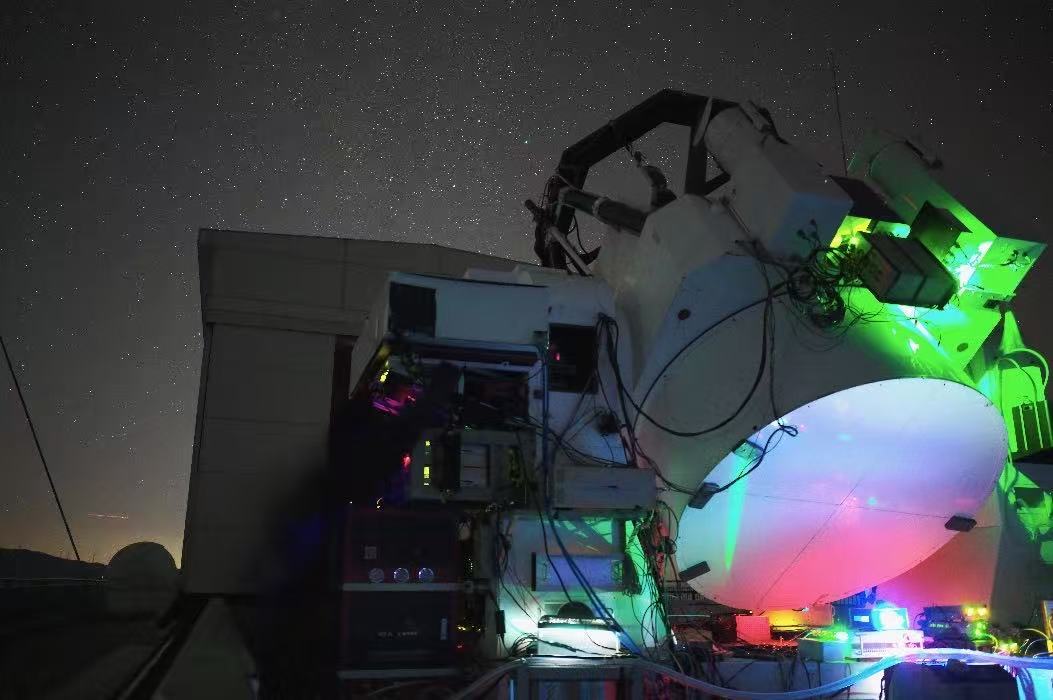
Lijiang Gaomeigu Observatory's 1.8-meter laser communication ground station
Recently, the Institute of Optics and Electronics under the Chinese Academy of Sciences, in collaboration with Beijing University of Posts and Telecommunications, Xi'an Branch of the China Academy of Space Technology (CAST), Aerospace Information University, and Guangyou Starlink, successfully established a laser communication link with a geostationary orbit satellite using a domestically developed 1.8-meter laser communication ground station at the Lijiang Gaomeigu Observatory. The experiment achieved bidirectional space-to-ground data transmission at a rate of 1 Gbps over a distance exceeding 40,000 kilometers, systematically overcoming key engineering challenges related to ultra-long-distance, high-speed, bidirectional interaction and sustained stable operation. This milestone represents a critical step toward building an integrated space-ground communication network.
Liu Chao, lead researcher of the project and a scientist at the Institute of Optics and Electronics, noted that previous communications between high-orbit satellites and ground stations suffered from signal instability, limited duration of only a few minutes, and severe asymmetry between uplink and downlink data rates. "It was like you sending ten messages while the other side could only reply with one—making efficient communication nearly impossible," he said.
To address this, the team established a stable laser-based "high-speed skyway" between space and Earth. Achieving such communication required two critical conditions: first, both ends must precisely "see" each other and successfully "establish contact"; second, the communication "channel" must remain continuously stable and unobstructed.
"This experiment not only realized communication but also extended its duration from 'minutes' to 'hours,'" Liu Chao stated. He emphasized that the system's reliable three-hour operation under real-world conditions marks a transition of the technology from a laboratory prototype to a stage of "operational readiness," providing a mature engineering model for future large-scale deployment. Furthermore, it opens the door to real-time "dialogue" with deep-space probes bound for the Moon, Mars, and beyond.
【本文部分内容由AI辅助生成,特此声明。The author(s) generated part of the content in this work with the assistance of artificial intelligence (AI), which is hereby declared.】
