
Sichuan Butterfly Census Reveals 1,002 Species, Nearly Half of China's Total
2026-02-25 10:52:31 by AIOS
Recently, whenever the weather is clear and temperatures rise above 15°C, Dr. Wang Lei of the Plant Protection Institute at the Provincial Academy of Agricultural Sciences, along with his teammates, carries a camera through Baheitan Wetland Park and Chengdu's Ring City Greenway, meticulously searching for butterflies among flowers and trees. "There's an Oriental Cabbage White! And over there is a Yellow Admiral!" teammate Dou Liang excitedly calls out. Wang quickly snaps a photo, capturing the moment a butterfly with snow-white wings marked by black spots spreads its wings, and carefully logs the time, location, and species—part of their ongoing winter butterfly monitoring in Chengdu.
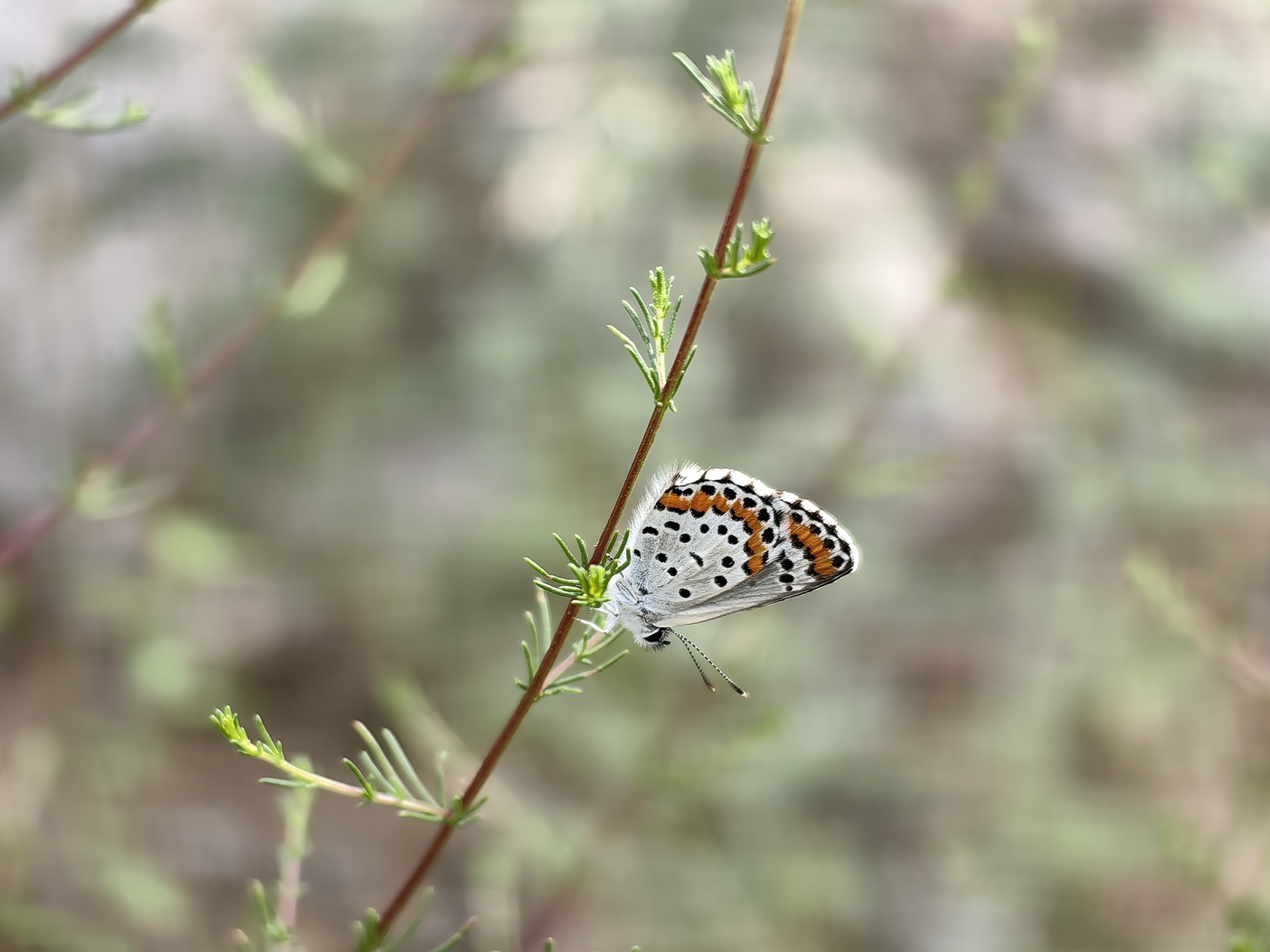
On August 12, 2025, a team discovered Aricia chinensis, a butterfly species newly recorded in 2025, in Danba County, Garze Tibetan Autonomous Prefecture
This monitoring effort is one component of the Sichuan Butterfly Census, jointly led by Wang Lei and Dou Liang, a curator at the Natural History Museum of Sichuan University. The "Butterfly Census" aims to systematically survey butterfly species, population sizes, migration patterns, and biodiversity across Sichuan Province, establishing a dedicated "ecological profile" for each species.
Why conduct such a census? In 2023, ground-based monitoring of ecological quality plots was fully launched, and butterflies—recognized as classic indicator species—were formally incorporated into the system. Wang explained that butterflies are highly sensitive to subtle changes in vegetation, water sources, climate, and pollution; fluctuations in their populations can reflect the health of regional ecosystems. A decline in local butterfly numbers may signal environmental degradation, food shortages, or human disturbance.

Dou Liang is examining a butterfly specimen
Moreover, the census helps clarify Sichuan's butterfly "inventory," identifying the distribution and population sizes of rare species such as the Golden Birdwing (Troides aeacus) and the Chinese Luehdorfia (Luehdorfia chinensis), thereby providing scientific support for endangered species conservation, ecological restoration, and territorial spatial planning.
How is the census conducted? First, a tiered monitoring network is established. Senior Engineer Li Bo from the Provincial Environmental Monitoring Center explained that since 2023, collaboration among the Provincial Academy of Agricultural Sciences, Sichuan University teams, and other institutions has made surveys more comprehensive and standardized. Over 800 ecological quality plots and nine national integrated monitoring stations have been set up across the province, covering core areas such as Wolong and Tangjiahe, as well as diverse habitats including the western Sichuan plateau, the Chengdu Plain, and southern Sichuan hills—significantly enhancing the representativeness of monitoring efforts.
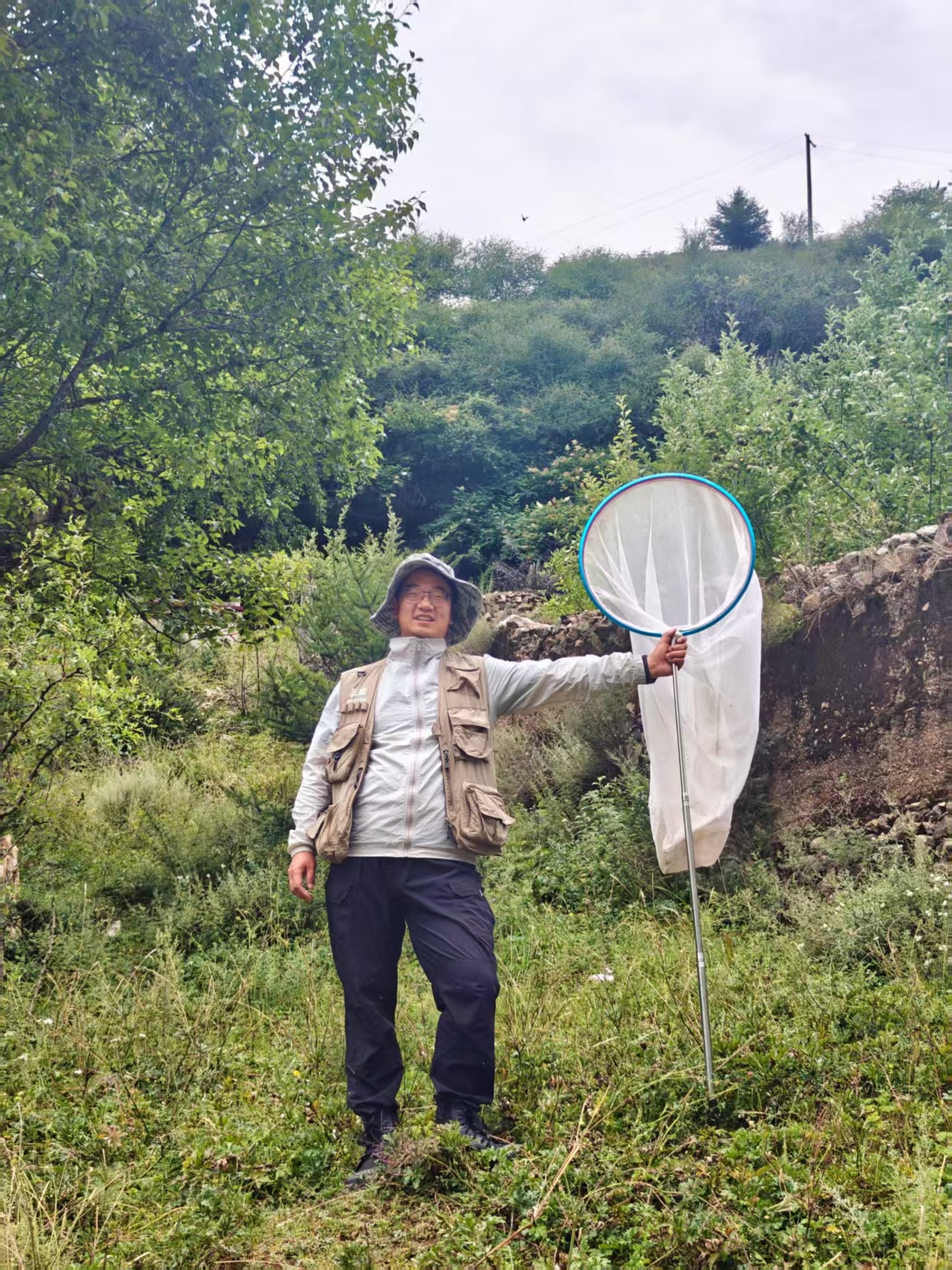
In August 2025, Wang Lei was surveying butterflies in Daofu County
In Chengdu, the team has established 20 survey transects. Wang noted that professional personnel carry out line-transect surveys, species identification, and fixed-point monitoring according to butterfly activity cycles, continuously accumulating data through a "record-what-you-see" approach. "Past monitoring focused on April to October, but in recent years, species such as the Orange Tip (Anthocharis cardamines) and the Small Tortoiseshell (Aglais urticae) have been observed in winter, challenging the long-held belief that 'there are no butterflies in winter.'"
Observation methods also follow strict protocols: first, locate targets with the naked eye; then photograph dorsal views to identify wing patterns and colors; simultaneously record habitat information such as elevation, temperature, humidity, and vegetation type. After fieldwork, laboratory specimen identification is used to correct any misidentifications, and all data are entered into a database to form a complete monitoring dataset.
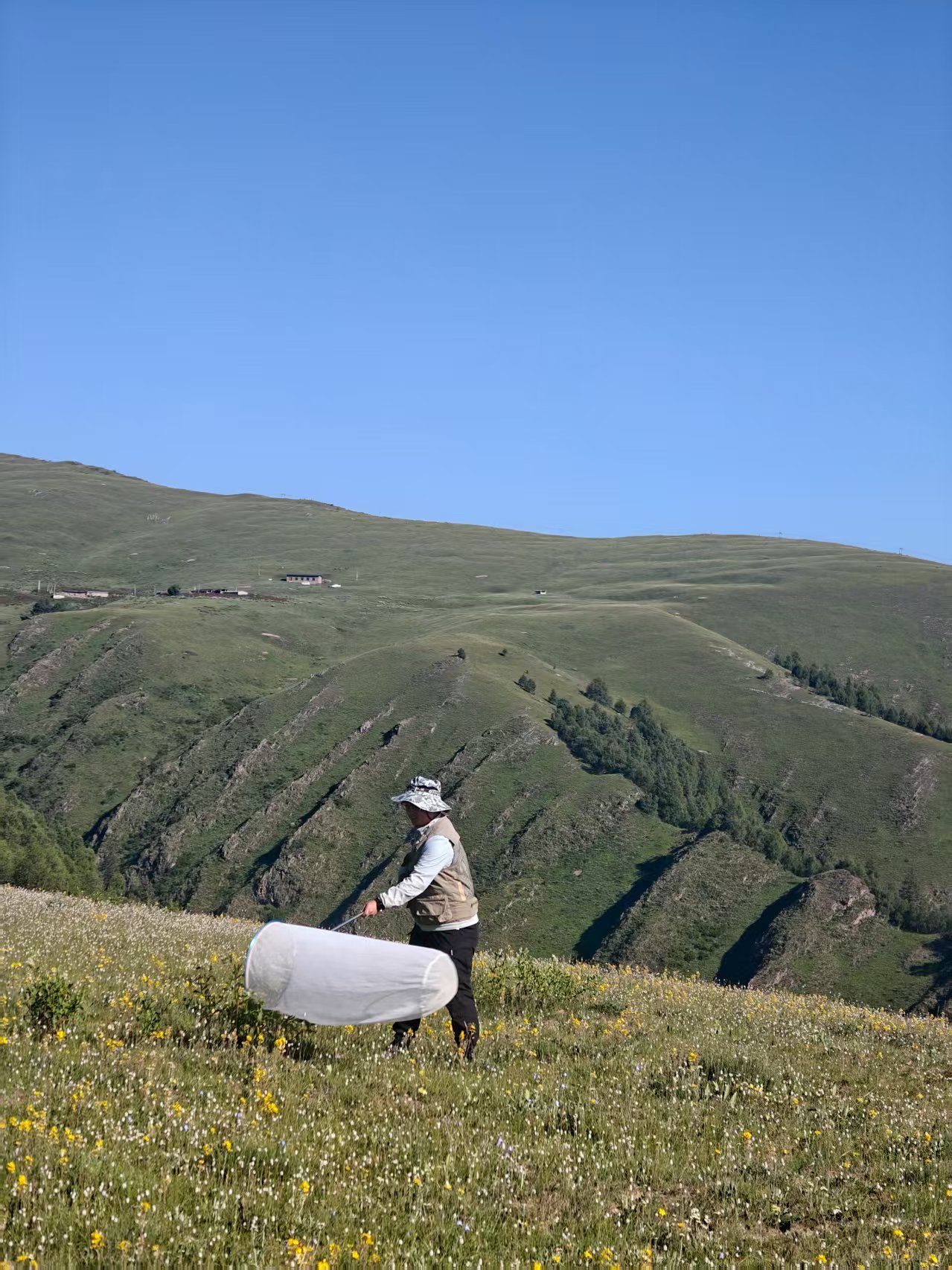
In August 2025, Wang Lei was surveying butterflies in Daofu County
The results have been significant: the updated 2025 checklist shows that 1,002 butterfly species have been recorded in Sichuan, an increase of 358 species from the 644 documented in 2020, accounting for 48% of China's total butterfly species—second only to Yunnan Province.
"The census is not just about collecting data; it must serve ecological conservation," Wang acknowledged frankly. The team has already recommended that Baheitan Wetland Park increase the proportion of host and nectar plants to support species like lycaenids, and advised urban landscaping authorities to avoid excessive pruning and indiscriminate pesticide use to protect larval habitats. "Conducting solid foundational research and offering actionable recommendations—that is the core value of this census.".
【本文部分内容由AI辅助生成,特此声明。The author(s) generated part of the content in this work with the assistance of artificial intelligence (AI), which is hereby declared.】
