
Sichuan State-Owned Enterprises Target High-Quality Growth in '15th Five-Year' Plan
2026-02-12 10:57:10 by AIOS
On January 22, the provincial state-owned assets and enterprises work conference was held in Chengdu. As the first major meeting of Sichuan's state-owned assets and enterprises system in 2026, the conference attracted significant attention. The year 2025 marks the concluding year of the 14th Five-Year Plan period, while 2026 ushers in the 15th Five-Year Plan period and represents a critical phase for Sichuan's state-owned assets and enterprises in optimizing layout, adjusting structure, and transforming growth drivers. The conference both reviewed past achievements and charted the course ahead.

The Luding Dadu River Bridge on the Ya'an–Kangding Expressway
Standing at this new starting point, Sichuan's state-owned assets and enterprises are firmly focused on high-quality development, striving to elevate reform and development to a new level and embarking on a transformative journey for the 15th Five-Year Plan period, thereby injecting robust state capital strength into Sichuan's modernization drive.
Over the past five years, Sichuan's state-owned assets and enterprises have delivered an extraordinary performance, playing a pronounced role as a 'stabilizer' and 'ballast stone'. Total assets of local state-owned enterprises in the province rose from RMB 10.75 trillion at the end of the 13th Five-Year Plan period to RMB 23.23 trillion by the end of the 14th Five-Year Plan period, surging across 13 consecutive trillion-yuan thresholds. Operating revenue surpassed RMB 2 trillion, and total profit exceeded RMB 100 billion, with average annual growth rates of 16.7%, 14.6%, and 5%, respectively.
State capital is accelerating its strategic reallocation toward emerging and substantive sectors. The six pillar industries now hold total assets of RMB 2.04 trillion, generate revenue of RMB 543.88 billion, and yield profits of RMB 101.56 billion—increases of 132.2%, 41.3%, and 59.1%, respectively, compared to the end of the 13th Five-Year Plan period. Key indicators for strategic emerging industries reached RMB 719.07 billion in assets, RMB 150.45 billion in revenue, and RMB 5.92 billion in profit, representing remarkable growth rates of 245.4%, 145.7%, and 91.9%, respectively, establishing a new industrial structure led by emerging industries, anchored by pillar industries, and supported by foundational sectors.
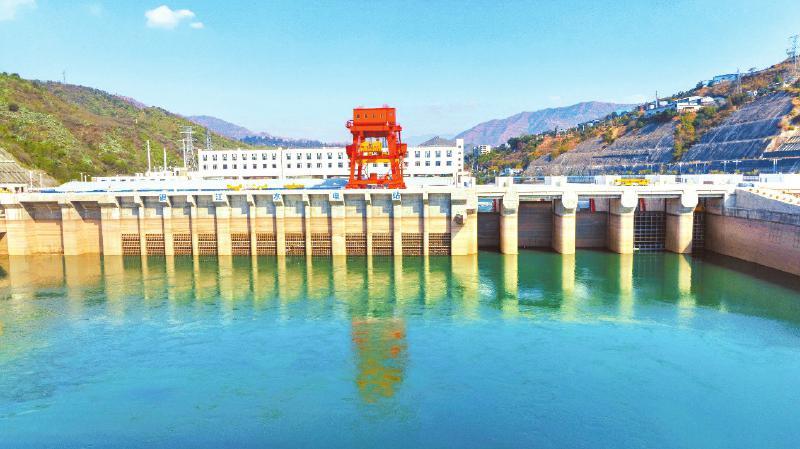
The Yinjiang Hydropower Station on the Jinsha River has been fully commissioned and is now generating power
Significant progress has been made in technological innovation. R&D investment reached RMB 21.71 billion, doubling since the end of the 13th Five-Year Plan period, with an average annual growth rate of 18.4%. The number of innovation platforms, including national and provincial key laboratories, has substantially increased, alongside a notable rise in the number of high-tech enterprises. More than 500 national and provincial science and technology projects have been implemented, yielding nearly 2,000 high-value patents and achieving major breakthroughs in core technologies such as integrated circuits and high-end instrumentation.
State-owned enterprise (SOE) reforms have yielded outstanding results. Through the three-year action plan and subsequent deepening initiatives, specialized reform programs such as the '1+6' and '1+8' schemes have been implemented, giving rise to industry leaders like Shudao Group and Sichuan Energy Group and achieving Sichuan’s first-ever entry into the Fortune Global 500. The number of enterprises with assets exceeding RMB 100 billion and revenue surpassing RMB 10 billion has reached 45 and 37, respectively. A modern corporate system with Chinese characteristics has been widely established, the 'three-system' reforms have been deepened, and institutional barriers have been effectively addressed.
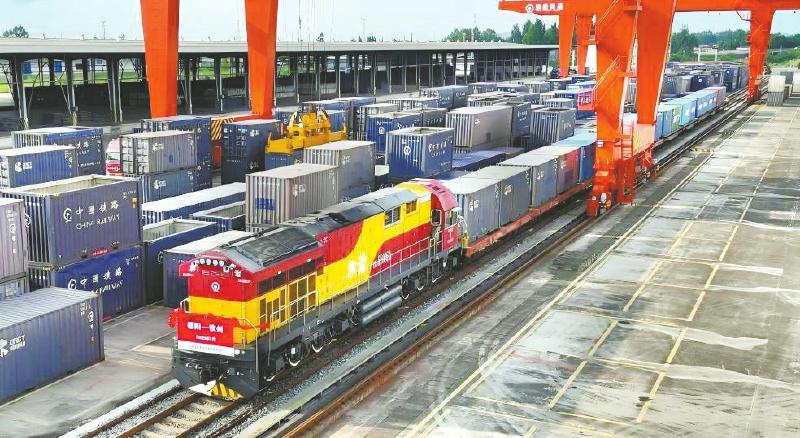
A train on the New Western Land-Sea Corridor service departed from Deyang bound for Qinzhou Port
The strategic supporting role of state-owned enterprises has become increasingly evident. In service of the Chengdu-Chongqing economic circle, major projects such as Tianfu International Airport and the Chengdu-Zigong-Yibin high-speed rail have been completed. Railway operating mileage has expanded by 1,700 kilometers, and expressway networks have grown by 3,000 kilometers. The 'SOEs Visit Cities and Prefectures' initiative has secured 355 signed projects with total investment exceeding RMB 1 trillion. Tax payments amounted to RMB 650.69 billion—doubling since the end of the 13th Five-Year Plan period. RMB 57.6 billion has been invested in rural revitalization, and 181,000 jobs have been created.
Looking ahead, over the next five years, Sichuan's state-owned assets and enterprises aim to achieve more pronounced quality and efficiency, a more solidified strategic role, a more optimized industrial layout, stronger innovation capabilities, and more efficient operations by the end of the 15th Five-Year Plan period, cultivating a cohort of enterprises with strong industrial control and international competitiveness.
Specifically, efforts will focus on five key areas: strengthening strategic support through increased investment in transportation, energy, and strategic mineral resources; optimizing the modern industrial layout by building a '15+N' key industrial system and driving the transformation and upgrading of traditional industries; reinforcing innovation leadership by maintaining stable R&D investment and promoting the integration of the 'four chains'—innovation, industry, talent, and capital; deepening reforms to refine the modern corporate system and enhance governance effectiveness; and optimizing regional and open development strategies by deepening Chengdu-Chongqing collaboration and central-local partnerships, with priority given to public services and locally advantageous industries.
Reflecting on the past, Sichuan's state-owned assets and enterprises have broken through challenges through reform and empowered growth through innovation, writing a chapter of leapfrog development. Looking to the future, they will remain anchored in high-quality development, deepen reform, drive innovation, and optimize layout to make greater contributions to the comprehensive construction of a modern socialist Sichuan.
【本文部分内容由AI辅助生成,特此声明。The author(s) generated part of the content in this work with the assistance of artificial intelligence (AI), which is hereby declared.】
