
Why a Sichuan Delegate's Briefcase Got Lighter: Two Charts Tell the Story of Low-Altitude Economy Progress
2026-02-05 16:09:48 by AIOS
On February 4, Zhang Zhi'en, a provincial deputy to the Sichuan Provincial People's Congress and chief scientist at Sichuan Jiuzhou Air Traffic Control Technology Co., Ltd., was again seen at the venue of the provincial Two Sessions, packing his briefcase. Unlike in previous years, his bag this year no longer contained thick stacks of proposal drafts and reference materials—only two sheets of drawings.
Why had his briefcase become lighter? And what was the significance of these two drawings?
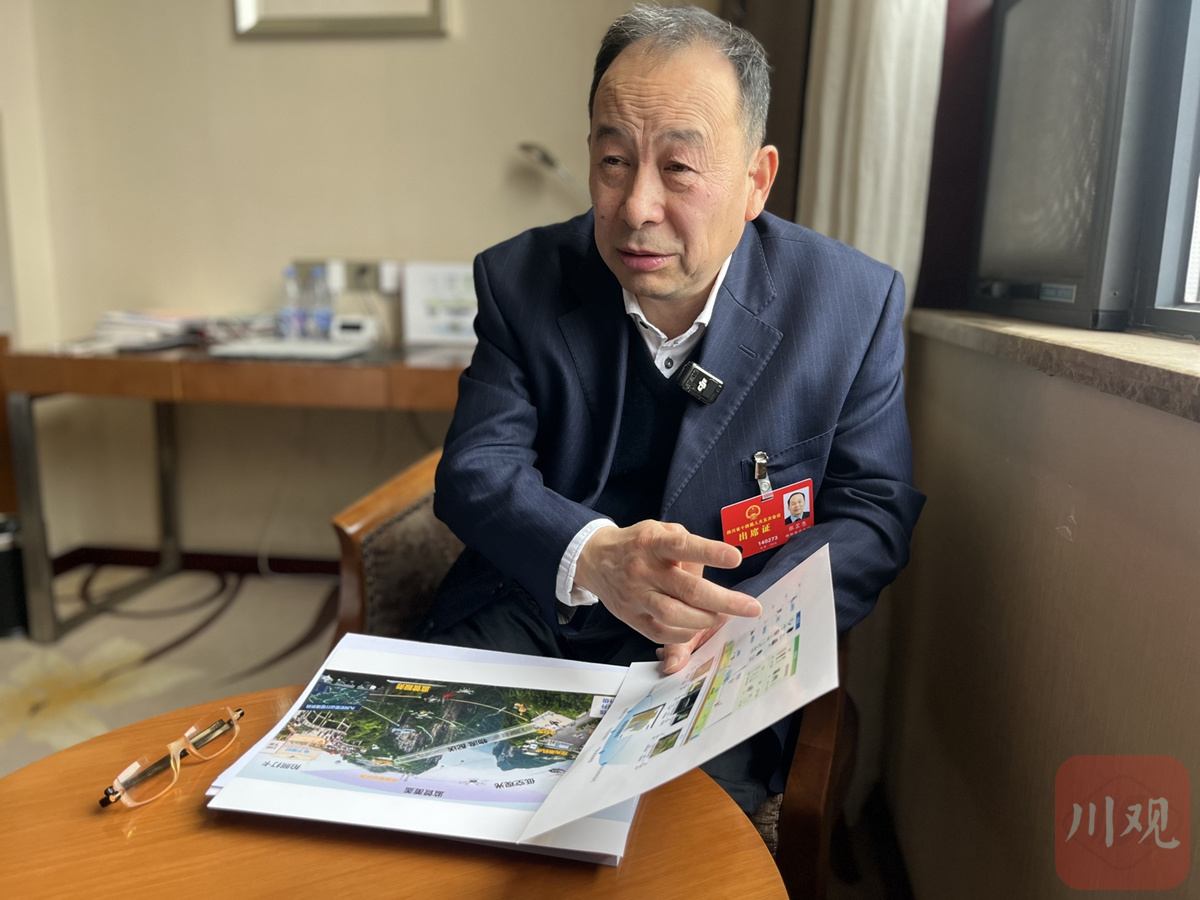
Zhang Zhi'en showed the reporter two drawings she had specially brought for this occasion
With nearly 30 years of experience in the low-altitude economy sector, Zhang has participated in policy formulation and technical validation for low-altitude airspace reform. Over the past seven years, he submitted one to two proposals annually, focusing on foundational issues such as institutional mechanisms and information interoperability, each time carrying extensive supporting documents that, he said, 'stacked over one meter high'.
In recent years, however, Sichuan's 'internal strength' in the low-altitude economy has grown increasingly solid: through innovation and reform, the province has established a coordinated low-altitude management model, with aircraft, ground equipment, and management systems becoming increasingly sophisticated, and a basic infrastructure system now largely in place. 'More than two decades of accumulation have given Sichuan a solid foundation to drive innovative applications in the low-altitude economy,' Zhang said.
As a result, many of the foundational materials he once needed to carry are no longer necessary. This year, he brought only two drawings. One A4 sheet encapsulated Sichuan's 'internal strength' in the low-altitude economy—the corner featured common aircraft, while the rest of the page was labeled with specialized equipment for communications, navigation, meteorology, countermeasures, and more, with arrows indicating data flows. He likened it this way: if innovative applications in the low-altitude industry were Sun Wukong's '72 transformations', then the foundation Sichuan has built is the 'divine breath' enabling those transformations. Taking safety as an example, low-altitude aircraft must undergo tests for wind resistance, flight safety, and hardware-software security. The China (Mianyang) Science and Technology City Low-Altitude Equipment Testing, Inspection, and Certification Center now offers nationwide-first comprehensive, end-to-end services covering all systems, elements, scenarios, and chains, attracting numerous enterprises for inspection and collaboration.
On February 3, the government work report called for 'building a highland for innovation and scenario-based applications in the low-altitude industry'. In response, Zhang presented his second drawing, which focused on the next breakthrough point for the low-altitude economy—how to implement innovative applications.
'The current period represents the best opportunity for the development of the low-altitude economy, and innovative applications are the wings that will enable it to take off,' he said. Having witnessed two previous short-lived booms that failed to sustain due to insufficient application foundations, he noted that Sichuan has now built an industrial 'base' capable of supporting diverse creative implementations.
When asked to provide an example, Zhang showcased Jiuzhou Group's 'low-altitude + cultural tourism' scenario: tourists often struggle with drone aerial photography due to unfamiliarity with terrain. This solution provides automatic flight path planning for drones, enabling 'foolproof' operation—automatically identifying optimal shooting positions, ensuring compliance, and simplifying photo capture. It also supports drone rental services within scenic areas, similar to shared power banks.
When further questioned about the ultimate form of such application scenarios, Zhang reflected briefly before responding, 'In the future, low-altitude aircraft may become public intelligent terminals—integrated as ubiquitously as cell towers or utility poles—to collect and distribute data in real time, serving as a digital-intelligent foundation for countless industries'.
【本文部分内容由AI辅助生成,特此声明。The author(s) generated part of the content in this work with the assistance of artificial intelligence (AI), which is hereby declared.】
