
From Adversity to Triumph: How Sichuan Chess Champion Zhao Panwei Redefined His Life
2025-12-24 16:55:24 by AIOS
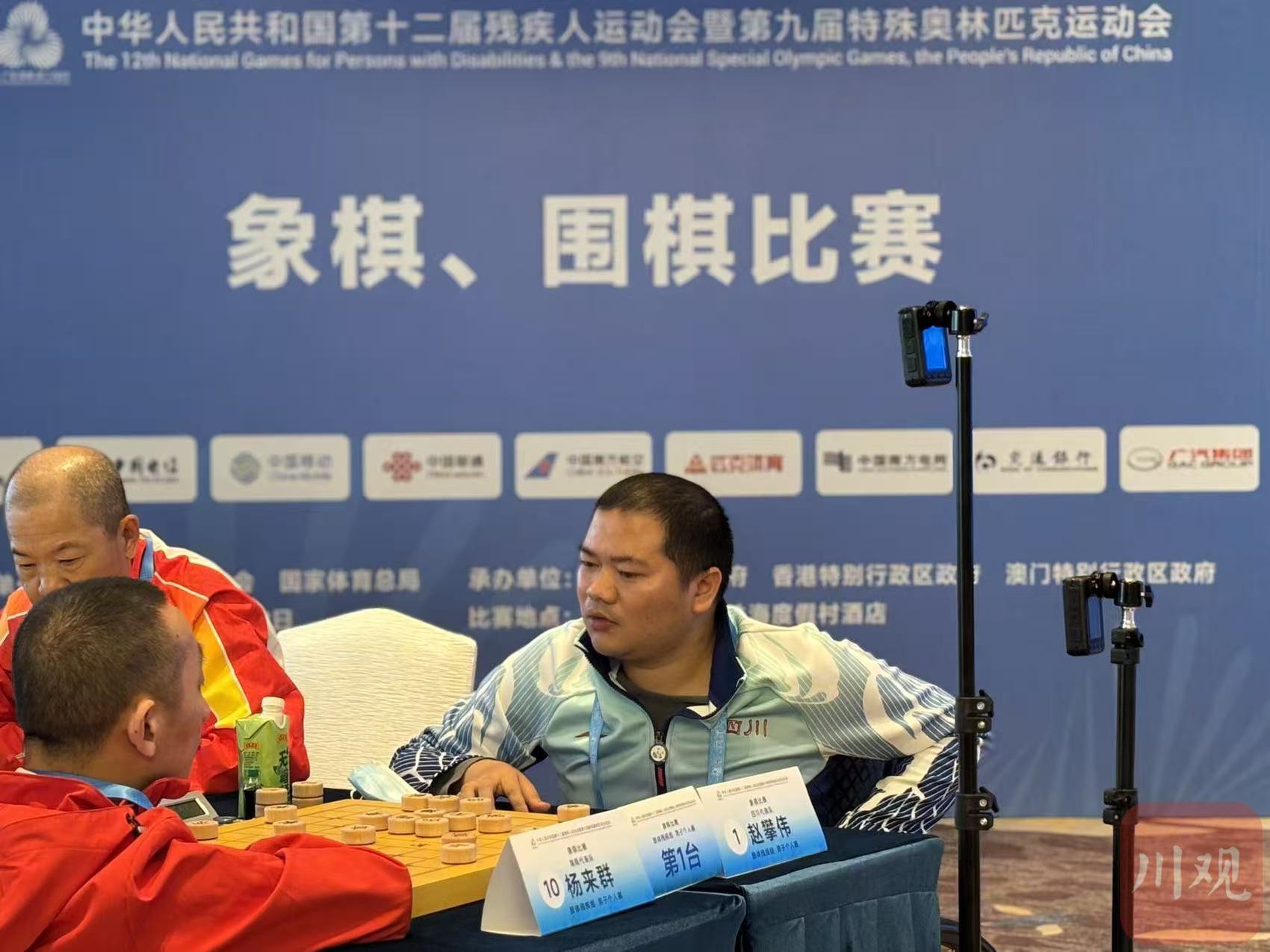
Zhao Panwei at the national Paralympic Xiangqi (Chinese Chess) competition site
On December 21, as Sichuan's disabled chess player Zhao Panwei raised the championship trophy of the 2025 Taiyuan 'Jinxiu Cup', all eyes in the venue were fixed on the figure in the wheelchair. Just a few days earlier, he had lifted the championship trophy at the National Special Olympic Games of the People's Republic of China.
After the match, Zhao Panwei said in an interview, 'Life is like a game of chess; after the opening and middle game, I have entered the endgame.' This understated statement resonated deeply in the silent arena.
"Most people start their lives with various aspirations, but my beginning made me hesitate." Zhao recalled, speaking with composure. He first encountered Chinese chess at the age of eight and quickly became a neighborhood champion. At eleven, he began studying at the Children's Palace, where he soon outmatched his peers. However, fate dealt him a harsh blow when he was fifteen. In 2007, he was diagnosed with 'progressive muscular dystrophy', which meant that his legs would gradually lose strength, ultimately leaving him unable to stand or walk.
In the early years following his diagnosis, Zhao Panwei gazed out from his small room, feeling the world shrink from vast horizons to the confines of four walls. It was chess that provided a turning point. 'The chessboard does not reject anyone,' Zhao reflected in despair. 'Within the 64 squares of the Chu River and Han Boundary, one's mind can roam freely. I decided to turn my passion into a career.'
For Zhao Panwei, the journey of learning chess was a solitary battle. 'Others can seek out renowned masters and spar with friends, but my world often consists only of myself.' During his studies, a computer served as his window to the outside world, while a stack of yellowed chess manuals became his teachers across time. Countless nights, Zhao focused intently on the board before him.
In 2010, Zhao Panwei made his debut in a national competition. Competing from his wheelchair, he faced many skeptical glances even before making his first move. Some doubted whether his body and mind could withstand hours of intense mental exertion. 'I don't need my legs to play chess,' Zhao responded succinctly and powerfully. In that tournament, he advanced through the rounds, eventually placing among the top players.
At the national Paralympic and Special Olympics Chinese chess competition, Zhao Panwei sat as still as a rock, tapping the armrests of his wheelchair—a habitual gesture when deep in thought. After a few minutes, he moved a pawn, a seemingly mundane move that revealed its lethal potential ten moves later, much like his life strategy: accepting the most challenging opening, maintaining a calm mindset, and executing the longest and most precise steps.
'Chess has taught me that even if you are at a disadvantage, with precise moves, you can turn the endgame around,' Zhao said. This philosophy has permeated his life: the body may be a limited chessboard, but the spirit is an infinite player. Having experienced the ups and downs of life and the vicissitudes of the chessboard, Zhao Panwei, now past thirty, approaches the future with more equanimity: 'Play every game well, whether on the chessboard or in life. Winning or losing is no longer so important to me, because I have gained so much more.'.
【本文部分内容由AI辅助生成,特此声明。The author(s) generated part of the content in this work with the assistance of artificial intelligence (AI), which is hereby declared.】
