
Chengdu doctors rushed to Africa to treat serious patients for 2 days
2021-11-09 10:50:26 by SICC
Dozens of scheduled operations have been suspended for nearly two months in a island country in west Africa, Sao Tome and Principe, due to shortages of supplies, anesthesiologists and nurses, and COVID-19. The 17th Sichuan Medical Assistance Team to Sao Tome, composed of obstetricians and gynecologists from the West China Second University Hospital, treated critically ill patients for two days in a row.

The 17th China (Sichuan) Medical Assistance Team to Sao Tome and Principe departed from Chengdu Shuangliu Airport on September 17, 2021
On November 1, 2021, the poorly equipped maternity ward at Sao Tome National Hospital was as busy as ever. There is always uncertainty in the maternity ward, so the cesarean operation needs to be done in time. However, one after one operations have overwhelmed the department. A hydatidiform mole clearance opeartion scheduled for that day might be also be canceled because of shortages in supplies, anesthesiologists and nurses, and COVID-19.

Dr Bai Lipin set out for Sao Tome
In the operating room, the local doctor asked Bai Liping from the West China Second University Hospital whether she had to operate on the hydatidiform mole patient today. Bai said, "Yes!" She did not hesitate, as the patient might massively bleed at any time. After the discovery of the need to operate a uterine curettage, the operation needed to be finished as soon as possible. If it can’t be done today, it’s possible that other operations may take its slot tomorrow. Anesthesiologists from Cuba, as well as local obstetricians and gynecologists and operating room nurses, were touched by Bai's insistence and they also quickly set to work.
The patient's cervix is small and thus extremely difficult to expose. Dr. Bai found it by her palpation and experience. The uterus of patients with hydatidiform mole is very soft, and the uterine perforation may lead to massive bleeding due to careless operation. However, with the experience accumulated in Chengdu, Dr. Bai successfully completed the operation in uterine curettage. The patient recovered well after the operation. The results of the reexamination of the color ultrasound showed that her uterine cavity had been clean. The patient is still being followed up.
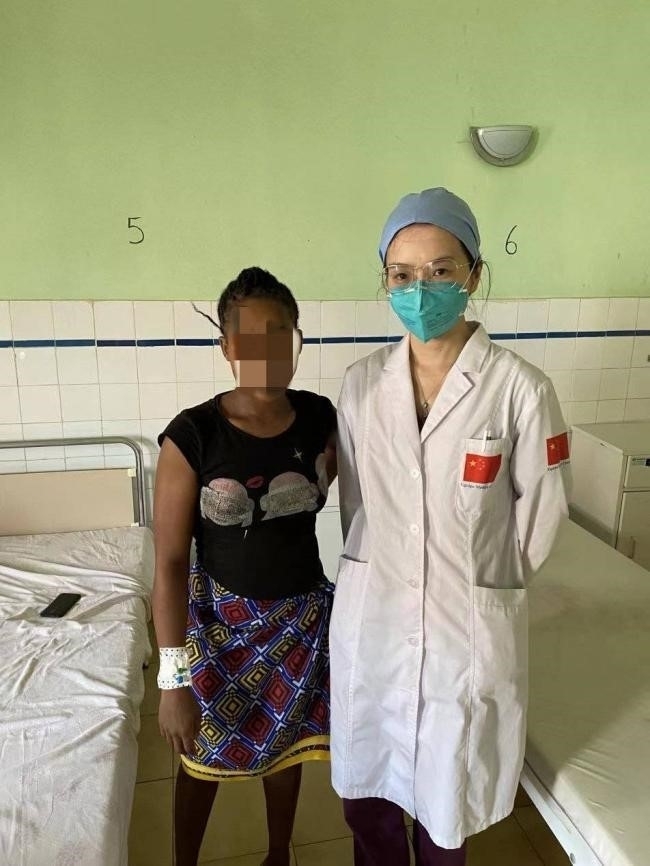
Dr. Bai and the patient after hydatidiform uterine curettage
On November 2, 2021, due to too many operations on the previous day, local doctors volunteered to ask Bai to take a rest, and they would go to have the operation. But then a doctor in the ward turned to Dr. Bai to consult a pregnant woman's fetalheartmonitor. The pregnant woman was given an intravenous drip of oxytocin for an overdue delivery. When the fetal monitor showed that the fetal heart rate continued to drop from more than 140 times/min to more than 50 times/min and did not recover, Dr. Bai immediately examined the patient and began preliminary intrauterine resuscitation.
This pregnant woman is a primipara: Her uterine orifice is 2 cm, and the membranes is broken, but there’s no amniotic fluid flow. Local doctors assisted Dr. Bai to examine the patient with the ultrasound, and there was no amniotic fluid at all. After intrauterine resuscitation, including withdrawal of oxytocin drip, left decubitus position, stimulation of the fetal scalp, the fetal heart slowly recovered to normal range. But the patient still had contractions, and after contractions, the fetal heart would drop, so the fetus was still in danger. Dr. Bai informed the local doctor that the pregnant woman needed an immediate operation. Then everyone sprang into action and pushed the pregnant woman into the operating room.
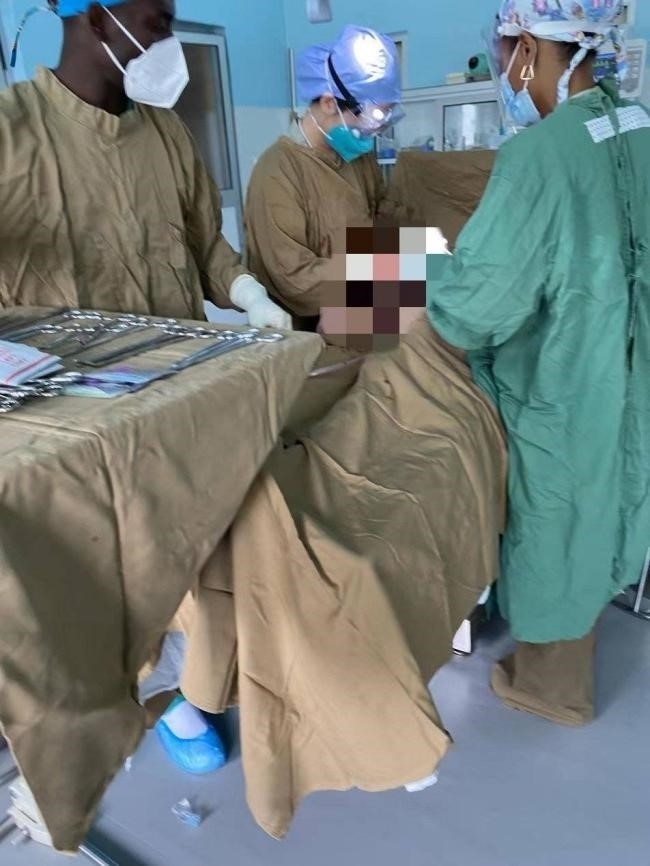
However, due to the limited medical facilities here, even if the operation is urgent, it must wait until the previous operation is finished before the operating room and anesthesiologist and operating room nurse can be available. There is no fetal monitoring equipment in the operating room. Thus, in the process of waiting, Dr. Bai borrowed the fetal heart handset from a local doctor. Bai used it to monitor the fetal heart for the pregnant woman, and comforted her to adjust the breath. In the end, the operation is successfully completed and both mother and baby are well. After the operation, Dr. Bai also taught local obstetricians and gynecologists how to do preliminary intrauterine resuscitation.

Despite the limited local medical conditions, all the medical staff worked together to overcome various difficulties, such as language barriers, poor equipment conditions and insufficient personnel. Doctors from several countries cooperated this time, and the dedication and superb skills of Chinese doctors have also been fully demonstrated.
