
The "iron-eating beast" of ancient times, nowadays is the "most popular animal" (January 1st 2022)
2022-01-06 06:52:05 by SICC

In terms of looks, they are the second most beautiful animal in the world. In terms of skills, they can fight for territory against the beasts in the forest, also can live in a zoo and make a living by " Mukbang ". In terms of merit, they are recognised as "cute diplomat" in China and a messenger of peace and friendship in the world.
It is the giant panda, first class national protected animals that is unique to China.
Wherever the giant panda is, it is the one that gets the most attention. When it's cold, someone turns on the air conditioning for it. When it's hungry, dieticians will give it a nutritious meal. When it’s sick, the doctors are more concerned than the panda itself. They even have expert guidance to help them breed. Of course, these treatments are only available to captive pandas, wild pandas have to work hard to live a happy life by themselves.
The giant panda has lived on earth for at least eight million years and is known as a 'living fossil'. It is said to have followed Chiyou into battle, to have warded off pestilence and disaster, and to have been an "iron-eating beast".
At first, the giant panda is meat-eater, but in the course of the natural evolution, the giant panda switched to a vegetarian diet in order to survive. In the process, T1R1 was inactivated in the giant panda's genes, rendering it unable to taste meat.
Nowadays, the giant panda is still classified as a carnivore. Although they are so cute, when angry they can be just as dangerous as bears. An adult giant panda eats 30kg of bamboo a day, but can only absorb about 17% of the nutrients in its food.
The life expectancy of a wild giant panda is between 18 and 20 years, and in captivity it can exceed 30 years.
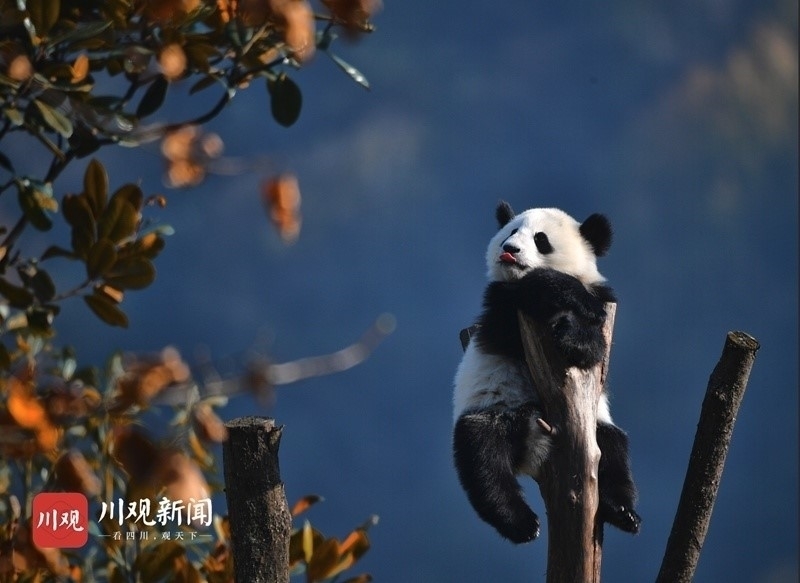
Since the 1960s, China has established a large number of nature reserves for giant pandas, implemented the Tianbao Project, the Returning Cropland to Forestland Project, wildlife protection, conducted artificial breeding research and wildlife release experiments, protected and restored the habitat of giant pandas, and achieved the recovery and expansion of wild and captive giant panda populations. The protection level has been reduced from "endangered" to "vulnerable".
As of October 1, 2021, the total number of giant pandas in captivity worldwide reached 673, with 1,864 pandas in the wild. Among them, Sichuan has 1,387 wild pandas and 548 captive pandas.
In October 2021, the Giant Panda National Park was officially established, with a planned area of 22,000 square kilometres, spanning Sichuan, Shaanxi and Gansu provinces. Of these, 19,300 square kilometres, or more than 87% of the total area, are in Sichuan province, involving 98 townships in 20 counties (cities and districts) in seven cities and states.
Profile:
Giant pandas, order Carnivora, Ursidae, are plump and fat as a bear, with a rounded head and short tail, a head and torso 1.2-1.8 m long and a tail 10-12 cm long. Weighing 80-120kg and heaviest up to 180kg. Giant pandas’s body colour is black and white, with rounded cheeks, big dark eyes, and also scalpel-sharp claws. The black and white appearance facilitates concealment in dense forest trees and on snowy ground without being easily detected by predators.
Wild giant pandas live in dense bamboo forests at an altitude of 2600-3500 meters. The giant panda is the ambassador of the World Wide Fund for Nature (WWF) and the flagship species of the world's biodiversity conservation. Giant pandas are endemic to China and their main habitat is Sichuan, Shaanxi and the mountainous regions of Gansu province.
